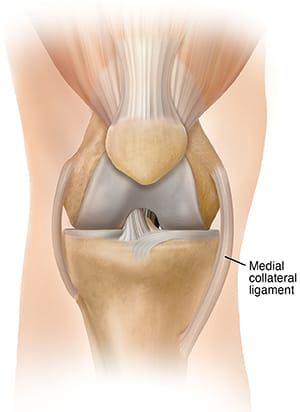
Treatment for an MCL injury can be nonsurgical or surgical. Nonsurgical treatment is used much more often. With either one, rehab will be part of your treatment.
Nonsurgical treatment
This treatment starts with rest, ice, and elevation. This eases pain and swelling. In the next stage, you start exercises to improve your knee's range of motion, strength, and flexibility. You may need a brace for weeks after your injury. Using crutches or a brace rests your joint, helping it to heal.
Surgery
Surgery is seldom used to fix an MCL injury. But sometimes it is advised, especially if some other part of your knee is hurt. Open surgery is used to screw or stitch the MCL back into place. If fixing the original MCL is not possible, an MCL graft may be used. Based on their location, other knee injuries may be fixed using arthroscopy. With arthroscopy, a tiny camera lets your doctor see inside the joint. Tools are put in through small cuts to fix the joint.
Pre-op checklist
- Stop taking aspirin and other medicines
7 days before surgery, or as your doctor directs. - Arrange to get correctly sized crutches to use as you heal.
- Don't eat or drink
10 to 12 hours before surgery, or as your doctor directs. - Arrange for someone to drive you home after surgery.
After surgery
Right after surgery, you'll spend a few hours in a recovery unit. Your knee will be bandaged. Ice will be applied, and your leg raised. Depending on the surgery performed, physical therapy may start shortly after. A brace and crutches are often used after surgery. You may have limits on weight bearing and activity while you heal.
Online Medical Reviewer: Rahul Banerjee MD
Online Medical Reviewer: Raymond Turley Jr PA-C
Online Medical Reviewer: Stacey Wojcik MBA BSN RN
Date Last Reviewed: 09/01/2025
© 2000-2026 The StayWell Company, LLC. All rights reserved. This information is not intended as a substitute for professional medical care. Always follow your healthcare professional's instructions.
Learn More About Health Services at PIH Health
Expert care for every stage of life. Explore the comprehensive services offered at PIH Health.
Explore Services
Get Health Tips & Updates
Sign up for helpful health information, wellness tips and news from PIH Health, delivered straight to your inbox.
SubscribeRelated Articles
Having Arm Fracture Open Reduction and Internal Fixation (ORIF)
Open reduction and internal fixation (ORIF) is a type of treatment to fix a broken bone. It puts the pieces of a broken bone back together so they can heal.
Treating Trigger Finger
The treatment for trigger finger may be nonsurgical or surgical, depending on how severe your condition is. Your healthcare provider can talk to you about the best choice for you.
Spinal Fusion: Posterior Lumbar
Fusing vertebrae in the lumbar curve spine may help ease lower back and leg pain. Posterior lumbar fusion is done through an incision in your back. The graft is put between the vertebrae in one of two places: in the disk space or between the transverse processes.
Hip Arthroscopy: Before Surgery
Learn more about hip arthroscopy and what you can do before your surgery.

Personalized Care Starts with the Right Provider
Search by specialty, location, and more.
Find A Doctor
Make an Appointment
Your health can't always wait. Schedule an appointment with a PIH Health provider.
Schedule an Appointment
Find a PIH Health Urgent Care Location
Need care today?. Find the nearest PIH Health Urgent Care location.
Find Urgent Care