Trigger finger occurs when the tissue inside your finger or thumb becomes inflamed. Mild cases can be treated without surgery. If the problem is severe, surgery may be needed. Your healthcare provider will talk with you about your choices.
Nonsurgical treatment
For most cases of trigger finger, your healthcare provider may have you rest the finger or thumb. You may also be told to take anti-inflammatory medicines. These include ibuprofen or aspirin. You may be given an injection of medicine in the base of the finger or thumb. This typically is a steroid, such as cortisone. Cortisone is a powerful anti-inflammatory and is very effective in curing most cases of trigger finger.
Surgery
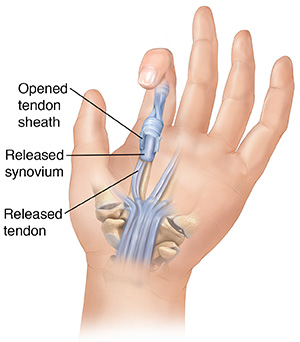
If nonsurgical treatments don’t ease your symptoms, you may need surgery. A tendon is a cord-like fiber that attaches muscle to bone and allows joints to bend. The tendon is surrounded by a protective cover called a sheath. During surgery, the sheath in your finger or thumb is opened to enlarge the space at the location of a ligament in your hand called the A1pulley and release the swollen tendon. This allows the finger or thumb to bend and straighten normally. Surgery takes about
Online Medical Reviewer: L Renee Watson MSN RN
Online Medical Reviewer: Raymond Turley Jr PA-C
Online Medical Reviewer: Thomas N Joseph MD
Date Last Reviewed: 09/01/2025
© 2000-2026 The StayWell Company, LLC. All rights reserved. This information is not intended as a substitute for professional medical care. Always follow your healthcare professional's instructions.
Learn More About Health Services at PIH Health
Expert care for every stage of life. Explore the comprehensive services offered at PIH Health.
Explore Services
Get Health Tips & Updates
Sign up for helpful health information, wellness tips and news from PIH Health, delivered straight to your inbox.
SubscribeRelated Articles
Treating Ankle Fractures
Treatment depends on where and how badly your ankle has been broken. A cast may be used to hold the bone in position for healing.
Foot Surgery: Flexible and Rigid Hammertoes
With hammertoes, one or more toes curl or bend abnormally. This can be caused by an inherited muscle problem, an abnormal bone length, or poor foot mechanics. There are many nonsurgical treatments for hammertoes, but if these are not effective, you may want to consider surgery.
Microdiskectomy
During a microdiscectomy, some disk is removed. In most cases, bone must first be removed to expose the damaged disk. The part of the disk outer wall and soft center that presses on the nerve can then be removed. There is usually enough disk remaining to cushion the vertebrae.
Patella (Kneecap) Dislocation or Subluxation, Reduced
The kneecap is held in place by ligaments and tendons. If the kneecap is hit with a strong force, it can slide too far to the side of the knee joint, tearing these ligaments and tendons. This sliding is called subluxation or dislocation.

Personalized Care Starts with the Right Provider
Search by specialty, location, and more.
Find A Doctor
Make an Appointment
Your health can't always wait. Schedule an appointment with a PIH Health provider.
Schedule an Appointment
Find a PIH Health Urgent Care Location
Need care today?. Find the nearest PIH Health Urgent Care location.
Find Urgent Care