The shoulder is your body’s most flexible joint. It lets the arm move in almost any direction. But this flexibility has a price—it makes the joint prone to injury. If you have a shoulder problem, a surgical procedure called arthroscopy may be able to help.
Your orthopedic evaluation
Your doctor will ask about your symptoms and the history of your shoulder problem. They will examine your shoulder and may give you tests, such as an X-ray, CT scan, or MRI. These help your doctor find the cause of your shoulder problem.
Arthroscopy: Looking inside your joint
Arthroscopy is a procedure that allows your surgeon to see and work inside your shoulder joint. Your surgeon makes small incisions in your shoulder and inserts a long, thin, lighted instrument called an arthroscope.
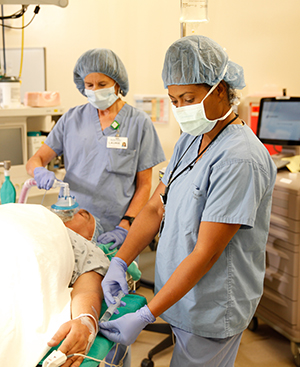
During surgery, the arthroscope sends live video images from inside your joint to a screen that your surgeon views. Using these images, your surgeon can diagnose and treat your shoulder problem. Because arthroscopy uses much smaller incisions than open surgery, recovery is often shorter and less painful. You will get anesthesia so you don't feel the arthroscopy. The anesthesia may be regional, general, or a combination.
Risks and possible complications of shoulder arthroscopy
-
Stiffness or ongoing pain in your shoulder
-
Bleeding or blood clots
-
Infection
-
Damage to nerves or blood vessels
You may still need open surgery after having arthroscopy.
Online Medical Reviewer: Stacey Wojcik MBA BSN RN
Online Medical Reviewer: Thomas N Joseph MD
Date Last Reviewed: 05/01/2025
© 2000-2026 The StayWell Company, LLC. All rights reserved. This information is not intended as a substitute for professional medical care. Always follow your healthcare professional's instructions.
Learn More About Health Services at PIH Health
Expert care for every stage of life. Explore the comprehensive services offered at PIH Health.
Explore Services
Get Health Tips & Updates
Sign up for helpful health information, wellness tips and news from PIH Health, delivered straight to your inbox.
SubscribeRelated Articles
Having Arm Fracture Open Reduction and Internal Fixation (ORIF)
Open reduction and internal fixation (ORIF) is a type of treatment to fix a broken bone. It puts the pieces of a broken bone back together so they can heal.
Nonsurgical Treatment Choices for Shoulder Impingement
Learn about the ways a shoulder impingement can be treated.
Treating Trigger Finger
The treatment for trigger finger may be nonsurgical or surgical, depending on how severe your condition is. Your healthcare provider can talk to you about the best choice for you.
Foot Surgery: Bunions
A bunion is a bony bump. When the distance between the first and second metatarsal bones of the foot is greater than normal, the big toe may turn toward the other toes. A mild bunion may then form causing foot pain and swelling. Bunions are most often found near the joint at the base of the big toe. Bunions tend to run in families. They may cause pain, swelling, and skin irritation.

Personalized Care Starts with the Right Provider
Search by specialty, location, and more.
Find A Doctor
Make an Appointment
Your health can't always wait. Schedule an appointment with a PIH Health provider.
Schedule an Appointment
Find a PIH Health Urgent Care Location
Need care today?. Find the nearest PIH Health Urgent Care location.
Find Urgent Care