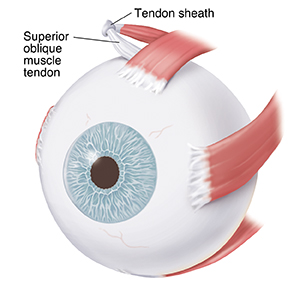
Brown syndrome is a problem with a tendon that attaches to the eyeball. The tendon is called the superior oblique muscle tendon. In Brown syndrome, this tendon can’t move freely. This limits the eye’s movement. Brown syndrome is a rare disorder. It's usually present at birth (congenital). In some cases, it occurs later in life (acquired).
Understanding eye movement
Eye movement is done with muscles and tendons attached to the eye. The superior oblique muscle tendon attaches to a small eye muscle. This muscle pulls the eye toward the middle, pulls the eye to look down, and rotates the eye. The superior oblique muscle tendon moves through a ring of tissue that surrounds it. The ring of tissue is called the tendon sheath.
What causes acquired Brown syndrome?
Brown syndrome is caused by problems with the superior oblique muscle tendon or its sheath. The muscle tendon or its sheath might be too short or thick. Acquired Brown syndrome is caused by things that shorten, thicken, inflame, or scar the muscle tendon or its sheath. Causes can include:
-
Injury
-
Inflammatory disease, such as lupus or rheumatoid arthritis (RA)
-
Complication from eye surgery
-
Inflammation of the white of the eye (scleritis)
-
Sinus infection
In some cases, the cause of acquired Brown syndrome isn't known.
Symptoms of acquired Brown syndrome
The symptoms may only be temporary. Brown syndrome most often affects only 1 eye. In rare cases, both eyes are affected. The symptoms can range from mild to severe.
If Brown syndrome affects the right eye:
-
You may not be able to look up with the right eye when looking to the left.
If Brown syndrome affects the left eye:
-
You may not be able to look up with the left eye when looking to the right.
Other signs and symptoms of Brown syndrome include:
-
Pain with eye movement
-
Double vision
-
Eyes not lined up with each other (strabismus)
-
Droopy eyelid (ptosis)
-
Can’t focus with both eyes unless you hold your chin up and tilt your head
Diagnosing acquired Brown syndrome
Diagnosis begins with a health history and physical exam. This includes a thorough eye exam. You may also have imaging tests. These can help give more information about the superior oblique muscle tendon.
Treatment for acquired Brown syndrome
Treatment for acquired Brown syndrome depends on its cause. And it depends on how severe the symptoms are. Brown syndrome caused by inflammation may be treated with corticosteroids. Or it may be treated with nonsteroidal anti-inflammatory medicine, such as ibuprofen. Treating the cause may also reduce symptoms. For example, Brown syndrome caused by lupus may be helped when the lupus is treated with corticosteroids.
You may need surgery if you have severe symptoms. During surgery, the surgeon cuts the superior oblique muscle tendon and uses a device to lengthen it. This can allow the muscle tendon to move normally.
Important
Let your healthcare provider know if your symptoms get worse.
Online Medical Reviewer: Heather M Trevino BSN RNC
Online Medical Reviewer: Jessica Gotwals RN BSN MPH
Online Medical Reviewer: Whitney Seltman MD
Date Last Reviewed: 08/01/2024
© 2000-2026 The StayWell Company, LLC. All rights reserved. This information is not intended as a substitute for professional medical care. Always follow your healthcare professional's instructions.
Learn More About Health Services at PIH Health
Expert care for every stage of life. Explore the comprehensive services offered at PIH Health.
Explore Services
Get Health Tips & Updates
Sign up for helpful health information, wellness tips and news from PIH Health, delivered straight to your inbox.
SubscribeRelated Articles
Understanding Nevus (Eye Freckle)
A nevus is a colored growth on your eye. It’s much like a mole on your skin.
Acute Narrow-Angle Glaucoma
Narrow-angle glaucoma occurs when the eye's fluid drainage system is blocked. It may cause permanent blindness within days if not treated.
Stye
A sty is when the oil gland of the eyelid becomes inflamed. It may develop into an infection with a small pocket of pus (an abscess). This can cause pain, redness, and swelling.
Retinal Tear
With age, the gel that fills the eye contracts, and can tear the retina. This causes floaters and flashes of light. It can lead to retinal detachment and vision loss.
Personalized Care Starts with the Right Provider
Search by specialty, location, and more.
Find A Doctor
Make an Appointment
Your health can't always wait. Schedule an appointment with a PIH Health provider.
Schedule an Appointment
Find a PIH Health Urgent Care Location
Need care today?. Find the nearest PIH Health Urgent Care location.
Find Urgent Care