Open reduction and internal fixation (ORIF) puts the pieces of a broken bone back together so they can heal. Open reduction means the bones are put back in place during a surgery through a surgical cut or an incision. Internal fixation means that special hardware is used to hold the bone pieces together. This helps the bone heal correctly. The procedure is done by an orthopedic surgeon. This is a doctor with special training in treating bone, joint, and muscle problems.
How does an ankle fracture happen?
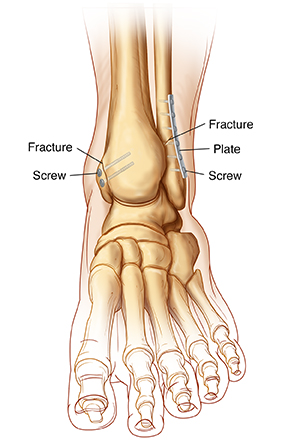
Three bones make up the ankle joint. These are the shinbone (tibia), the smaller bone in your leg (fibula), and a bone in your foot (talus).
Different kinds of injuries can damage the lower tibia, lower fibula, or talus. In some cases, only one of these bones might break, or you may have a break in two or more of these bones. The bones may break, but the pieces are still lined up correctly, or they may be broken and not lined up correctly.
Why is an ankle fracture ORIF done?
You are more likely to need ORIF if:
-
The bones of your leg are out of alignment.
-
One or more bones broke through the skin.
-
Your bones broke into several pieces.
-
Your ankle is unstable (the ankle joint itself is displaced or can be displaced when it is subjected to normal forces).
How is an ankle fracture ORIF done?
An ORIF surgery may be done under general anesthesia (you sleep through the surgery and won’t feel anything) or under local anesthesia and a medicine to help you relax (sedation).
During an open reduction, the bone pieces are put back in their proper alignment. The bones are then connected back in place with hardware. This is called internal fixation. The hardware may include screws, plates, rods, wires, or nails.
What are the risks of ankle fracture ORIF?
All types of surgeries have risks. Your risks vary based on your age and general health. For example, if you are a smoker or if you have low bone density, you may have a higher risk for certain problems. People with poorly controlled diabetes may also have a higher risk for problems. Talk with your health care provider about which risks apply most to you. Some of the main risks of ankle fracture ORIF include:
-
Infection.
-
Bleeding.
-
Nerve damage.
-
Damage to blood vessels or tendons.
-
Skin complications.
-
Misaligned bone or bone that does not heal.
-
Blood clots.
-
Fat embolism.
-
Irritation of the area from the hardware.
-
Arthritis.
-
Problems from anesthesia.
-
A need for more surgery.
Online Medical Reviewer: Marianne Fraser MSN RN
Online Medical Reviewer: Raymond Turley Jr PA-C
Online Medical Reviewer: Shaziya Allarakha MD
Date Last Reviewed: 03/01/2025
© 2000-2026 The StayWell Company, LLC. All rights reserved. This information is not intended as a substitute for professional medical care. Always follow your healthcare professional's instructions.
Learn More About Health Services at PIH Health
Expert care for every stage of life. Explore the comprehensive services offered at PIH Health.
Explore Services
Get Health Tips & Updates
Sign up for helpful health information, wellness tips and news from PIH Health, delivered straight to your inbox.
SubscribeRelated Articles
Foot Surgery: Flexible and Rigid Hammertoes
With hammertoes, one or more toes curl or bend abnormally. This can be caused by an inherited muscle problem, an abnormal bone length, or poor foot mechanics. There are many nonsurgical treatments for hammertoes, but if these are not effective, you may want to consider surgery.
Kneecap Surgery: Removing Damaged Cartilage
Surgery may be used when pain severely limits your activities. Or it may be done when a rehab program or other nonsurgical treatments just are not helping enough. Some procedures may be done using arthroscopy. This method uses tiny incisions and special instruments to look and work inside the knee joint. Other procedures need open surgery.
Foot Surgery: Curled Fifth Toe
A curled fifth toe is most often inherited. When the fifth toe curls inward, it moves under the next toe. Then the nail of the curled toe starts to face outward. As a result, you may bear weight on the side of your toe instead of the bottom. This can cause corns and painful nails. There are many nonsurgical treatments available. But if these are not effective, surgery is a choice.
Understanding Achilles Tendon Repair Surgery
Achilles tendon repair surgery is a type of surgery to fix a damaged Achilles tendon.

Personalized Care Starts with the Right Provider
Search by specialty, location, and more.
Find A Doctor
Make an Appointment
Your health can't always wait. Schedule an appointment with a PIH Health provider.
Schedule an Appointment
Find a PIH Health Urgent Care Location
Need care today?. Find the nearest PIH Health Urgent Care location.
Find Urgent Care