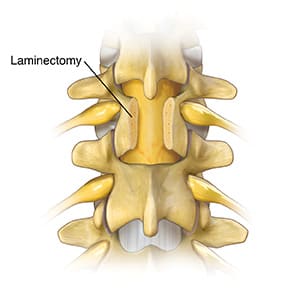
Vertebrae are the bones that make up the spine. Laminectomy is a surgery that removes the part of the vertebra called the lamina. This takes pressure off nerves in the low back and helps reduce symptoms. A similar surgery is called a laminotomy. For a laminotomy, only part of the lamina is removed.
A laminectomy is usually done to remove pressure from the spinal cord or the nerve roots. It can also be done to access a tumor, an infection, an abnormal blood vessel, or a blood clot. A laminectomy can be followed by a fusion of the vertebrae.
Before your surgery
Be sure to follow all of your doctor's instructions on getting ready for surgery.
- Follow any directions you're given for not eating or drinking before surgery.
- If you take a daily medicine, ask if you should still take it the morning of surgery.
- If you take any blood-thinning medicines, such as aspirin, discuss them with your doctor at least a week before surgery.
- At the hospital, your temperature, pulse, breathing, and blood pressure will be checked.
- An I.V. (intravenous) line will be started to provide fluids and medicines needed during surgery.
During your surgery
- Once in the operating room, you'll be given anesthesia.
- After you are asleep, a cut (incision) is made near the center of your low back. The incision may be 2 to 6 inches long, depending on how many vertebrae are affected.
- During a laminectomy, the lamina, or bone that forms the back of the spinal canal, is removed from the affected vertebra. The opening created may be enough to take pressure off the spinal cord or the nerve roots. If needed, your doctor can also remove any bone spurs or disc matter pressing on the nerve root. After laminectomy, the opening in the spine is protected by the thick back muscles, which are closed over the bony defect.
- Once the nerve is free of pressure, the incision is closed with stitches or surgical staples.
- You may have one or two drains in place to help move fluid from your wound to the bulb outside your body. These tubes will be removed in the next few days.
After your surgery
After surgery, you'll be sent to the post-anesthesia care unit (PACU). When you're fully awake and stable, you'll be moved to your room. The nurses will give you medicines to ease your pain. You may have a small tube (catheter) in your bladder. Soon, health care providers will help you get up and moving. You'll also be shown how to keep your lungs clear with coughing and deep breathing exercises.
When to contact your doctor
Once at home, contact your doctor if you have any of the symptoms below:
- Abnormal redness, heat, or fluid leaking at the incision site
- More pain, numbness, or weakness in your leg
- Fever over 100.4°F (38°C) or higher, or as advised by your doctor
Online Medical Reviewer: Anne Fetterman RN BSN
Online Medical Reviewer: Joseph Campellone MD
Online Medical Reviewer: Raymond Kent Turley BSN MSN RN
Date Last Reviewed: 04/01/2024
© 2000-2026 The StayWell Company, LLC. All rights reserved. This information is not intended as a substitute for professional medical care. Always follow your healthcare professional's instructions.
Learn More About Health Services at PIH Health
Expert care for every stage of life. Explore the comprehensive services offered at PIH Health.
Explore Services
Get Health Tips & Updates
Sign up for helpful health information, wellness tips and news from PIH Health, delivered straight to your inbox.
SubscribeRelated Articles
Hip Arthroscopy: Labral Tears
Arthroscopy can be used to repair tears in the strong, flexible ring of cartilage attached to the edge of the hip socket, called the labrum.
Splints and Casts
Splints and casts are used to help support and protect a variety of bone and soft tissue injuries. They keep an injured area from moving.
Surgery for Shoulder Impingement: Your Experience
Surgery can help free up space in your shoulder joint. This relieves symptoms of impingement. Prepare for surgery as instructed. If you don’t, your surgery may have to be rescheduled. Your healthcare provider will give you instructions for recovering at home. If you have any questions, be sure to get them answered.
Hip Arthroscopy: After Surgery
Know what to expect after arthroscopy on your hip.

Personalized Care Starts with the Right Provider
Search by specialty, location, and more.
Find A Doctor
Make an Appointment
Your health can't always wait. Schedule an appointment with a PIH Health provider.
Schedule an Appointment
Find a PIH Health Urgent Care Location
Need care today?. Find the nearest PIH Health Urgent Care location.
Find Urgent Care