Taking your pulse is a way to measure your heart rate. When you take your pulse, you are feeling the force of blood as it’s pumped from your heart into your body. You may be asked to take your pulse regularly. Or you may just need to take it when you exercise or when you feel something is wrong.
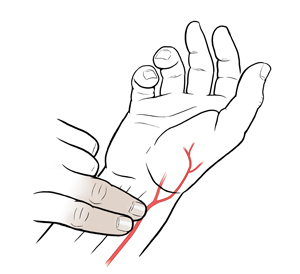
Step 1. Find your pulse
-
With your first 2 fingers, press lightly on the inside of your wrist, just below the base of the thumb. You should not be pressing on a bone. Don't use your thumb.
-
The beats you feel are your pulse. If you can’t find your pulse, try moving your fingers slightly to a new spot.
Step 2. Take your pulse
-
Count the beats you feel in your wrist as you watch the second hand on a clock. You may be told to count the beats for 30 seconds, then multiply that number by 2. Or you may be told to count for a full minute. Both methods should give you about the same result.
-
The number you get is your pulse measurement. It's measured in beats per minute (bpm). A normal pulse when you are at rest is between 60 and 100 beats per minute. The beats should be regular (evenly spaced). If the beats are not regularly spaced, let your health care provider know.
Step 3. Write down the results
-
Write down your pulse each time you take it. You may be asked to bring your results with you each time you visit your provider.
Online Medical Reviewer: Ronald Karlin MD
Online Medical Reviewer: Stacey Wojcik MBA BSN RN
Online Medical Reviewer: Steven Kang MD
Date Last Reviewed: 02/01/2025
© 2000-2026 The StayWell Company, LLC. All rights reserved. This information is not intended as a substitute for professional medical care. Always follow your healthcare professional's instructions.
Learn More About Health Services at PIH Health
Expert care for every stage of life. Explore the comprehensive services offered at PIH Health.
Explore Services
Get Health Tips & Updates
Sign up for helpful health information, wellness tips and news from PIH Health, delivered straight to your inbox.
SubscribeRelated Articles
Controlling Your Risk Factors After Bypass Surgery
After coronary bypass surgery, it's important to control the risk factors that led to heart disease to prevent future heart attacks and the need for more treatment.
Pacemaker Failure
Pacemakers are reliable life-saving devices, but problems do rarely occur. It is important to understand why you have a pacemaker. This can also help you understand why it might fail.
Taking Potassium
Potassium supplements help replace potassium your body as lost. This can happen if you take a water pill (diuretic), or because of a medical condition. Read on for tips on how to take potassium, as well as safety advice.
Understanding Remote Pulmonary Artery Pressure Monitoring
Remote pulmonary artery pressure monitoring is used to manage heart failure. It can tell if your heart failure is getting worse before you even notice any changes to your condition.

Personalized Care Starts with the Right Provider
Search by specialty, location, and more.
Find A Doctor
Make an Appointment
Your health can't always wait. Schedule an appointment with a PIH Health provider.
Schedule an Appointment
Find a PIH Health Urgent Care Location
Need care today?. Find the nearest PIH Health Urgent Care location.
Find Urgent Care