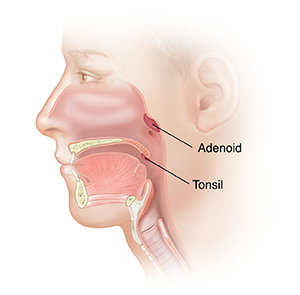
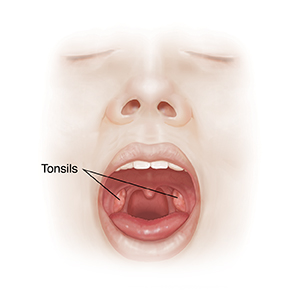
Tonsils and adenoids are clusters of lymph tissues in the back of the throat. These tissues form part of the body’s immune system, which helps the body fight disease. If these structures often become infected or become enlarged, it can lead to problems. They may then need to be removed with surgery. Surgery to take out the tonsils is called tonsillectomy. In some cases, the adenoids are also taken out. This is called adenoidectomy.
Why tonsillectomy and adenoidectomy are done
You may have your tonsils, adenoids, or both removed for reasons such as:
-
Infection of the tonsils (tonsillitis) that keeps coming back.
-
Repeated infections of the throat.
-
Enlargement of the tonsils or adenoids that affects breathing during sleep. This causes a condition called obstructive sleep apnea.
-
Suspected cancer of the throat.
Tonsillectomy can remove part or all of the tonsils.
How tonsillectomy and adenoidectomy are done
This surgery is done in a hospital or surgery center. It often takes less than an hour.
-
An intravenous (I.V.) line is put into a vein in your arm or hand. This gives you fluids and medicines.
-
You are given general anesthesia to put you into a deep sleep during the procedure.
-
A special device is used to hold your mouth open. A tube is put down into your throat to help keep your airway open during the procedure.
-
The doctor uses surgical tools to take out the tonsils and possibly the adenoids.
-
After you are awake and recovered from the anesthesia, you are sent home.
Risks of tonsillectomy and adenoidectomy
Risks include:
-
Bleeding.
-
Electric burns of the mouth and lip.
-
Infection.
-
Injury to the lips or teeth.
-
Numbness of the tongue.
-
Nausea and vomiting.
-
Risks of anesthesia.
-
The need for a second surgery.
-
Voice changes.
Author: Michels, Karen
Online Medical Reviewer: Ashutosh Kacker MD
Online Medical Reviewer: Ronald Karlin MD
Online Medical Reviewer: Tara Novick BSN MSN
Date Last Reviewed: 08/01/2025
© 2000-2026 The StayWell Company, LLC. All rights reserved. This information is not intended as a substitute for professional medical care. Always follow your healthcare professional's instructions.
Learn More About Health Services at PIH Health
Expert care for every stage of life. Explore the comprehensive services offered at PIH Health.
Explore Services
Get Health Tips & Updates
Sign up for helpful health information, wellness tips and news from PIH Health, delivered straight to your inbox.
SubscribeRelated Articles
Nasal Surgery: Turbinate Surgery
This surgery fixes a blockage caused when the turbinates in your nose are too large.
Mastoidectomy and Meatoplasty
Mastoidectomy and meatoplasty are types of ear surgery. Mastoidectomy removes part of the mastoid bone (the large bone behind the earlobe). Meatoplasty makes the opening into the ear canal (meatus) larger.
Before Middle Ear Surgery
You are having surgery on your middle ear. This sheet can help you get ready. If you have any questions, ask your healthcare provider beforehand.
Meatoplasty (Ear)
Meatoplasty is a type of ear surgery that is done on the opening into the ear canal (meatus). Learn what to expect before, during, and after this surgery.

Personalized Care Starts with the Right Provider
Search by specialty, location, and more.
Find A Doctor
Make an Appointment
Your health can't always wait. Schedule an appointment with a PIH Health provider.
Schedule an Appointment
Find a PIH Health Urgent Care Location
Need care today?. Find the nearest PIH Health Urgent Care location.
Find Urgent Care