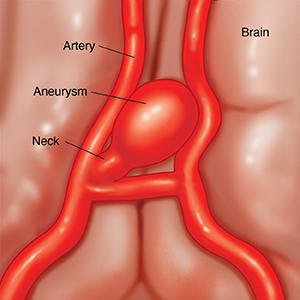
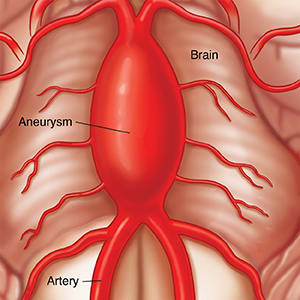
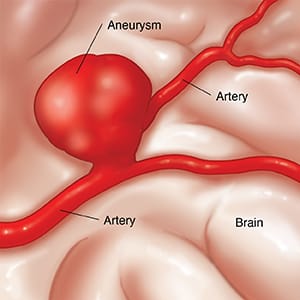
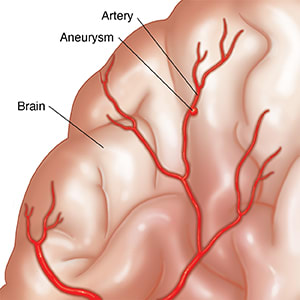
There are several types of brain aneurysms that are classified by shape. These are saccular (also called berry) aneurysms, which are by far the most common. Less common are the fusiform and dissecting types. Brain aneurysms may also be classified by:
- Size (small, large, and giant)
- Location
- Cause (such as a mycotic aneurysm, caused by an infection)
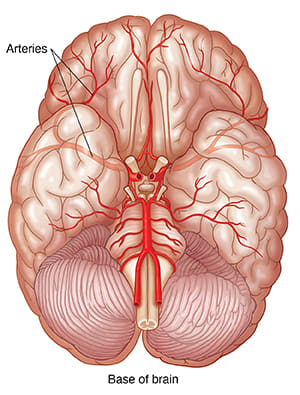
Most aneurysms occur where an artery branches, often at the base of the brain. The risk of an aneurysm bursting (rupturing) can be affected by the shape and location of the aneurysm. The treatment choices vary, depending on the type of aneurysm, its size, and its location.
Online Medical Reviewer: Chris Southard RN
Online Medical Reviewer: Marianne Fraser MSN RN
Online Medical Reviewer: Melinda Murray Ratini DO
Date Last Reviewed: 03/01/2024
© 2000-2026 The StayWell Company, LLC. All rights reserved. This information is not intended as a substitute for professional medical care. Always follow your healthcare professional's instructions.
Learn More About Health Services at PIH Health
Expert care for every stage of life. Explore the comprehensive services offered at PIH Health.
Explore Services
Get Health Tips & Updates
Sign up for helpful health information, wellness tips and news from PIH Health, delivered straight to your inbox.
SubscribeRelated Articles
Understanding Corticobasal Degeneration (CBD)
CBD causes some parts of the brain to shrink and lose nerve cells. This happens over time in the outer layer of the brain (cortex).
Cranial Neuropathies
Cranial neuropathy is a disorder that causes nerve damage in the nerves that arise from the brain and brainstem. This disorder can affect the ability of the face and eyes to feel and move.
Understanding Vasovagal Syncope
Vasovagal syncope is fainting caused by a complex nerve and blood vessel reaction in the body. It's the most common cause of fainting. Unlike other causes of fainting, it's not a sign of a problem with the heart or brain.
Bell’s Palsy
Bell’s palsy is a nerve disorder that usually happens suddenly and without warning. This condition happens when a nerve that controls facial movement is damaged. Nerve damage can happen for many reasons. But most cases of Bell’s palsy are probably caused by a virus.

Personalized Care Starts with the Right Provider
Search by specialty, location, and more.
Find A Doctor
Make an Appointment
Your health can't always wait. Schedule an appointment with a PIH Health provider.
Schedule an Appointment
Find a PIH Health Urgent Care Location
Need care today?. Find the nearest PIH Health Urgent Care location.
Find Urgent Care