Your baby had a procedure called circumcision. This is a procedure to remove the baby’s foreskin. The foreskin is the layer of skin that covers the tip (glans) of the penis. It's most often done in the nursery before a baby goes home from the hospital, if the family chooses to have it done. Circumcision can be done in a number of ways. The doctor will explain the procedure and tell you what to expect. Follow the guidelines on this sheet and instructions from your baby's doctor to care for your baby after the circumcision.
What to expect
-
A crust of bloody or yellowish coating may appear around the head of the penis. This is normal. Don't clean off the crust or it may bleed.
-
The penis may swell a little or bleed a little around the incision.
-
The head of the penis might be slightly red or black and blue.
-
Your baby may cry at first when urinating, or be fussy for the first couple of days.
-
Skin-to-skin cuddling and breastfeeding may help reduce pain.
-
The skin should heal in about
7 to 10 days .
Keep the penis clean
-
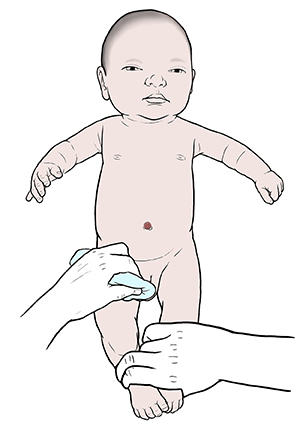
Gently wash the penis with warm water during diaper changes if there is stool on it.
-
Use a soft washcloth. Don't rub the sore area. It may slow healing or cause bleeding.
-
Let the skin air-dry.
-
Change diapers often to help prevent infection.
-
Coat the head of the penis with petroleum jelly and gauze if the doctor says to.
For the Gomco or Mogen clamp
-
If there is gauze or a bandage on the penis, follow the doctor's specific instructions on when to remove it, replace it, or both.
For the Plastibell device
-
Let the ring fall off by itself. This may take between
3 to 10 days . -
Call your baby's doctor if the ring falls off in the first
2 days or stays on for more than10 days .
When to contact the doctor
Contact your baby's doctor if:
-
Your baby's penis is very red or swells a lot.
-
Your child has a fever of 100.4°F (38°C) or higher, or as advised by the doctor.
-
Your child is acting very ill, listless, fussy, or refuses to eat.
-
There is discharge or drainage that looks cloudy or does not go away.
-
Bleeding can't be stopped by applying gentle pressure or is larger than a quarter-size on the diaper.
-
Your baby is not urinating normally.
Featured in
Online Medical Reviewer: Donna Freeborn PhD CNM FNP
Online Medical Reviewer: Heather Trevino
Online Medical Reviewer: Liora C Adler MD
Date Last Reviewed: 06/01/2025
© 2000-2026 The StayWell Company, LLC. All rights reserved. This information is not intended as a substitute for professional medical care. Always follow your healthcare professional's instructions.
Learn More About Health Services at PIH Health
Expert care for every stage of life. Explore the comprehensive services offered at PIH Health.
Explore Services
Get Health Tips & Updates
Sign up for helpful health information, wellness tips and news from PIH Health, delivered straight to your inbox.
SubscribeRelated Articles
Discharge Instructions: When Your Baby Spits Up or Vomits
It's easy for a little bit of the baby's stomach contents to leave the stomach, travel up the esophagus (food pipe), and come out through the mouth. This is called "spitting up," and it's normal. But spitting up is not the same as vomiting, which can sometimes be a sign of a serious problem. This sheet will help you understand the difference.
Infant Play
Read on for helpful suggestions for activities and toys for your baby, according to their age.
Giving Your Baby a Bath
Here are images that show the steps for giving your baby a bath.
Bathing Your Newborn
Until your newborn's umbilical cord falls off, sponge baths are the best way to bathe your baby. Gather supplies ahead of time. Bathe your newborn every 2 to 3 days, using the steps below as a guide. You can wash the diaper area more frequently as needed to keep the baby clean.

Personalized Care Starts with the Right Provider
Search by specialty, location, and more.
Find A Doctor
Make an Appointment
Your health can't always wait. Schedule an appointment with a PIH Health provider.
Schedule an Appointment
Find a PIH Health Urgent Care Location
Need care today?. Find the nearest PIH Health Urgent Care location.
Find Urgent Care