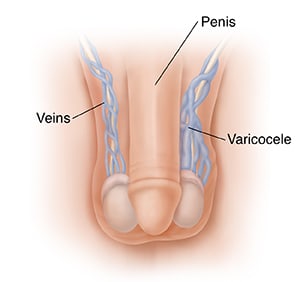
A varicocele is a swelling in the veins above the testicles. It's similar to having varicose veins in the legs. The swelling occurs when too much blood collects in the veins because they're damaged. A varicocele most often occurs above the left testicle.
How to say it
VAYR-ih-koh-SEEL
Veins in the scrotum
The scrotum is a sac of skin that covers the testicles. These are the male sex organs that make sperm and male hormones. Blood vessels in the scrotum carry blood to and from the testicles. The vessels that carry blood away from the testicles are called veins.
When there’s a problem in the veins
The veins that carry blood from the testicles extend up into the groin. That means the blood has to travel upward a long way. Valves in the veins act like gates to keep the blood from flowing back toward the testicles. Sometimes these valves don't close fully. Or the muscles in the walls of the veins may be weak. Then some blood flows back into the scrotum and collects in the veins above the testicles. This makes the veins enlarge.
What are the symptoms?
A varicocele often causes no symptoms at all. Or it may cause an achy or heavy feeling in the scrotum. The pain may be worse later in the day or after standing for a long time. You may also see swollen veins just under the skin in the scrotum.
A varicocele can lower sperm count
When blood collects in the veins above the testicles, changes occur. These changes can reduce the number and the quality of the sperm. In many cases, sperm count improves after treatment.
Online Medical Reviewer: Donna Freeborn PhD CNM FNP
Online Medical Reviewer: Marc Greenstein MD
Online Medical Reviewer: Raymond Kent Turley BSN MSN RN
Date Last Reviewed: 08/01/2023
© 2000-2026 The StayWell Company, LLC. All rights reserved. This information is not intended as a substitute for professional medical care. Always follow your healthcare professional's instructions.
Learn More About Health Services at PIH Health
Expert care for every stage of life. Explore the comprehensive services offered at PIH Health.
Explore Services
Get Health Tips & Updates
Sign up for helpful health information, wellness tips and news from PIH Health, delivered straight to your inbox.
SubscribeRelated Articles
Testicular Appendage Torsion
Testicular appendage torsion is the twisting of a small piece of tissue above a testicle. This can cause pain and swelling that gets worse over time. Learn more about this condition, including what causes it, what the symptoms are, and how it's diagnosed and treated.
Catheter-Linked Urinary Tract Infections
A catheter-associated urinary tract infection (CAUTI) is an infection of the urinary system. CAUTI is caused by germs that get into the urinary tract when a urinary catheter is used. This is a tube that's placed into the bladder to drain urine.
Urethritis Due to Gonorrhea or Chlamydia (Adult Male)
Urethritis is an infection in the urethra. It's often caused by gonorrhea or chlamydia. This infection needs antibiotics. Learn more about home care.
Understanding Bladder Stones
Bladder stones are small deposits of crystals made from minerals and proteins that form in the urine. They may form when a small amount of urine stays in your bladder after urinating.
Personalized Care Starts with the Right Provider
Search by specialty, location, and more.
Find A Doctor
Make an Appointment
Your health can't always wait. Schedule an appointment with a PIH Health provider.
Schedule an Appointment
Find a PIH Health Urgent Care Location
Need care today?. Find the nearest PIH Health Urgent Care location.
Find Urgent Care