You may go home the same day as your surgery, or you may need to stay in the hospital longer. These first few days after your surgery can be a challenge. You’ll have lots of help from your healthcare team. And you’ll learn how to care for yourself once you’re home.
Right after surgery
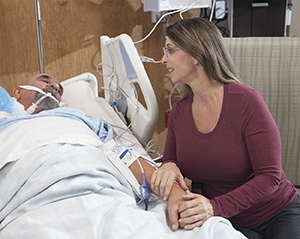
You’ll wake up in the ICU (intensive care unit). An IV (intravenous) line may be in your arm to provide fluids. You may have an air tube in your nose or a tracheostomy tube in your throat to help you breathe. You may also have a tube in your stomach to provide food. You may feel tired, confused, or groggy. This is normal. The confusion may last for a while. Your mouth or throat may feel dry or sore. Talking may be hard, so something to write with may be at your bedside.
Before leaving the hospital
Your healthcare providers will check on you after your surgery. They’ll explain what you need to do to recover at home. Have an adult family member or friend with you so any questions you have can be answered before you leave. Ask your family member or friend to write down the answers so you won't forget. You may be given medicines to take after you leave the hospital. Make sure an adult friend or family member is available to drive you home.
When to call your healthcare provider
Call your provider right away if you have any of these problems after surgery:
-
Bleeding or swelling in the mouth or throat
-
Fever of
100.4 °F (38 °C) or higher, or as advised by your provider -
Vomiting
-
Shortness of breath
-
Swelling in the legs or feet
-
Pain that’s not relieved by medicine
-
Symptoms that get worse or new symptoms
Call 911
Call 911 right away if you have:
-
Trouble breathing
Featured in
Online Medical Reviewer: Ashutosh Kacker MD
Online Medical Reviewer: Marianne Fraser MSN RN
Online Medical Reviewer: Melinda Murray Ratini DO
Date Last Reviewed: 04/01/2024
© 2000-2026 The StayWell Company, LLC. All rights reserved. This information is not intended as a substitute for professional medical care. Always follow your healthcare professional's instructions.
Learn More About Health Services at PIH Health
Expert care for every stage of life. Explore the comprehensive services offered at PIH Health.
Explore Services
Get Health Tips & Updates
Sign up for helpful health information, wellness tips and news from PIH Health, delivered straight to your inbox.
SubscribeRelated Articles
Mouth and Throat Tumors
Learn about mouth and throat tumors, including who's at risk and symptoms.
Intraperitoneal (IP) Therapy for Cancer
Intraperitoneal (IP) therapy is a treatment for cancer in the stomach. Learn more detailed information here.
Cancer Care: Controlling Diarrhea
A common side effect of cancer and cancer treatment is diarrhea. This is when you have loose, watery stools or pass stool more often than usual. To help limit this problem, try these tips.
Distal Ureterectomy
Cancer has been found in the lower (distal) part of one of your ureters. To treat the cancer, distal ureterectomy is done. This surgery removes the lower part of the ureter and part of the bladder. Read on to learn more about this procedure and what to expect.

Personalized Care Starts with the Right Provider
Search by specialty, location, and more.
Find A Doctor
Make an Appointment
Your health can't always wait. Schedule an appointment with a PIH Health provider.
Schedule an Appointment
Find a PIH Health Urgent Care Location
Need care today?. Find the nearest PIH Health Urgent Care location.
Find Urgent Care