You are going home with stitches, surgical staples, special strips of surgical tape, or surgical skin glue. These items were used to close your incision, help stop bleeding, and speed healing. It's important to follow your doctor's instructions for cleaning your incision. Below are some tips to help your incision heal.
Home care
-
Clean your work area:
-
Put pets in another room.
-
Clean your work area with soap and water.
-
Spread a clean cloth or paper towel over the surface.
-
Move away from the clean surface if you need to cough or sneeze.
-
-
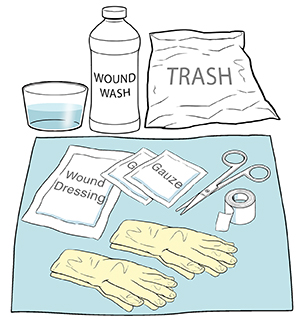
Gather your supplies. You'll need:
-
Packaged dressing for your wound.
-
Irrigation solutions (if prescribed by your doctor).
-
Pair of scissors (cleaned with soap and water).
-
Medical tape.
-
Disposable gloves (2 pairs).
-
Clean plastic trash bag (open it before you wash your hands).
-
-
Wash your hands:
-
Use liquid soap.
-
Work up a good lather and scrub for 20 seconds.
-
Be sure to scrub between your fingers and under your nails.
-
Rinse with clean, running water.
-
Use a clean paper towel to dry your hands and turn off the faucet.
-
-
Prepare your dressing supplies:
-
Peel back the edges of the dressing packages. Pour any irrigation solutions into solution cups.
-
Cut each piece of tape 4 inches longer than the dressing.
-
-
Remove the old dressing:
-
Put on the first set of disposable gloves.
-
Loosen the tape on the dressing by pulling gently toward the incision. Remove the dressing 1 layer at a time. Put it in the plastic bag immediately.
-
Remove your gloves and put them in the plastic bag. Wash your hands.
-
Put on a new pair of gloves.
-
-
Clean and dress the incision:
-
Irrigate and clean the incision and apply a new dressing as directed.
-
Put all used supplies in the plastic bag. Remove your gloves last and put them in the plastic bag. Seal the bag and put it in the trash.
-
Be sure to wash your hands again.
-
Care for specific closures
Follow these guidelines unless your doctor tells you otherwise:
-
Stitches or staples. Once you no longer need to keep these dry, clean the wound daily, using the instructions listed above. First remove the bandage using clean hands. Then wash the area gently with soap and clean, running water. Use a wet cotton swab to loosen and remove any blood or crust that forms. After cleaning, put a thin layer of antibiotic ointment on if your doctor instructed you to do so. Then put on a new bandage.
-
Skin glue. Don’t put liquid, ointment, or cream on your wound while the glue is in place. Avoid activities that cause heavy sweating. Protect the wound from sunlight. Don't scratch, rub, or pick at the glue. Don't put tape directly over the glue. The glue should peel off within 5 to 10 days.
-
Surgical tape. Keep the area dry. If it gets wet, blot the area dry with a clean towel. Surgical tape usually falls off within 7 to 10 days. If it has not fallen off after 10 days, contact your doctor before taking it off yourself. If you are told to remove the tape, it can be removed by pulling on it gently from the edge. For pieces that are stuck firmly, put mineral oil or petroleum jelly on a cotton ball. Gently rub the tape until it's removed.
Follow-up care
Follow up with your doctor to ask how long stitches or staples should be left in place. Be sure to return for suture or staple removal as directed. If tape closures were used, remove them yourself when your doctor tells you to, if they have not fallen off on their own. If skin glue was used, the glue will wear off by itself. Call your doctor if you have any questions or concerns about how to care for your incision at home.
When to seek medical care
Call your doctor right away if you have:
-
More pain, bleeding, redness, or foul-smelling discharge around the incision area.
-
A fever of
100.4 °F (38 °C) or higher, or as directed by your doctor. -
Shaking chills.
-
Vomiting or nausea that doesn’t go away.
-
Numbness, coldness, or tingling around the incision area.
-
Opening of the stitches or wound.
-
Stitches or staples come apart or fall out.
-
Surgical tape falls off before 7 days, or as directed by your doctor.
Online Medical Reviewer: Stacey Wojcik MBA BSN RN
Online Medical Reviewer: Steven Kang MD
Date Last Reviewed: 05/01/2025
© 2000-2026 The StayWell Company, LLC. All rights reserved. This information is not intended as a substitute for professional medical care. Always follow your healthcare professional's instructions.
Learn More About Health Services at PIH Health
Expert care for every stage of life. Explore the comprehensive services offered at PIH Health.
Explore Services
Get Health Tips & Updates
Sign up for helpful health information, wellness tips and news from PIH Health, delivered straight to your inbox.
SubscribeRelated Articles
Uvulopalatopharyngoplasty (UPPP)
Uvulopalatopharyngoplasty (UPPP) can treat your snoring or sleep apnea (a condition that affects nighttime breathing). Learn about the procedure and what to expect.
Hospital Discharge
Hospital discharge is when you are allowed to leave a hospital after treatment. It involves working with a discharge planner who will help you understand the next steps and how to care for yourself at home.
Preventing a Surgical Site Infection
This sheet tells you more about surgical site infections, what hospitals are doing to prevent them, and how they are treated if they do occur. It also tells you what you can do to prevent these infections.
After Laparoscopic Hernia Repair
A hernia is a defect in the tough tissue covering the musculature of the abdominal wall (fascia). During laparoscopic hernia surgery, a surgeon inserts a telescope attached to a camera as well as surgical instruments through tiny incisions in your abdomen. The surgeon repairs the hernia with a mesh, which patches the tear or weakness in the fascia.

Personalized Care Starts with the Right Provider
Search by specialty, location, and more.
Find A Doctor
Make an Appointment
Your health can't always wait. Schedule an appointment with a PIH Health provider.
Schedule an Appointment
Find a PIH Health Urgent Care Location
Need care today?. Find the nearest PIH Health Urgent Care location.
Find Urgent Care