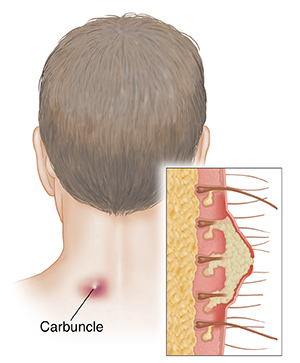
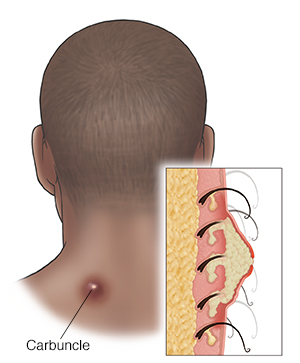
A carbuncle is a painful boil under the skin or a cluster of several boils (furuncles). It happens when a group of hair follicles become infected. Follicles are the tiny holes from which hair grows out of your skin.
How to say it:
KAR-bun-kuhl
What causes carbuncles?
A carbuncle is often caused by an infection with bacteria ( Staphylococcus aureus ). They are common on areas of the body where friction and sweat occur. They often appear on the back of the neck, back, and thighs. This type of infection can also happen when the skin is injured, such as by a cut or bug bite.
The bacteria that cause carbuncles can spread easily from person-to-person. People at higher risk for boils are those with diabetes or a weak immune system. Illegal drug users who use needles are also more likely to get them.
Symptoms of carbuncles
A carbuncle starts as a small painful bump. But it can grow quickly. It may become red, swollen, and sore.
Carbuncles may ooze pus. They may also cause fever and a general feeling of illness.
Treatment for carbuncles
A carbuncle may heal on its own in a few weeks. But the pus inside it needs to come out first. Treatment choices include:
-
Warm compress. Putting a warm, wet washcloth on the boil will help the pus drain out. You should never try to pop a boil. That can cause the infection to spread. To prevent spreading bacteria, wash the towel well after using it.
-
Antibiotics. In some cases, oral antibiotics may be prescribed to fight the infection, especially if the carbuncle returns. You'll likely have to take the medicine for 5 to 7 days. You may need to take it longer for a severe case.
-
Surgical drainage. If the boil doesn’t drain on its own, your health care provider may need to cut into it. This is called an incision and drainage. Never try to squeeze a carbuncle yourself. There’s a risk that you’ll spread the infection.
-
Good hygiene. Proper handwashing can prevent boils from spreading and coming back. Also wash things that have been in contact with the carbuncle in hot water. This includes things like clothing and towels.
Complications of carbuncles
The main complication of a carbuncle is the spreading of the infection. The infection will often be contained with treatment. But it may spread into the nearby skin. In severe cases, the bacteria can go deeper, even infecting the heart or bone. Bacteria in the bloodstream can also lead to septic shock, a life-threatening reaction.
When to call your doctor
Contact your health care provider or get medical care right away if you have:
-
A fever of 100.4°F (38°C) or higher, or as directed by your provider.
-
Redness, swelling, or fluid leaking from a carbuncle that gets worse.
-
Pain that gets worse.
-
Symptoms that don’t get better or that get worse.
-
New symptoms.
Author: Semko, Laura
Online Medical Reviewer: Daphne Pierce-Smith RN MSN
Online Medical Reviewer: Lalitha Kadali
Online Medical Reviewer: Rita Sather RN
Date Last Reviewed: 03/01/2025
© 2000-2026 The StayWell Company, LLC. All rights reserved. This information is not intended as a substitute for professional medical care. Always follow your healthcare professional's instructions.
Learn More About Health Services at PIH Health
Expert care for every stage of life. Explore the comprehensive services offered at PIH Health.
Explore Services
Get Health Tips & Updates
Sign up for helpful health information, wellness tips and news from PIH Health, delivered straight to your inbox.
SubscribeRelated Articles
Psoriasis
Detailed information on psoriasis, including causes, symptoms, diagnosis, and treatment.
Warts (Nongenital)
Warts are caused by HPV (human papillomavirus). They often appear on the hands, face, or feet. Here are some ways to treat warts at home.
Plantar Warts
Warts on the soles of the feet are called plantar warts. These warts are not a serious health problem. They usually go away without treatment.
Understanding Hidradenitis Suppurativa
Hidradenitis suppurativa is a long-term (chronic) skin disease. It causes painful bumps and sores to form around a hair follicle.

Personalized Care Starts with the Right Provider
Search by specialty, location, and more.
Find A Doctor
Make an Appointment
Your health can't always wait. Schedule an appointment with a PIH Health provider.
Schedule an Appointment
Find a PIH Health Urgent Care Location
Need care today?. Find the nearest PIH Health Urgent Care location.
Find Urgent Care