Genes are inherited from our biological parents in specific ways. One of the basic patterns of inheritance of our genes is called X-linked dominant inheritance.
What is X-linked dominant inheritance?
X-linked dominant inheritance happens when a gene responsible for a trait or disorder is located on the X chromosome. The gene acts in a dominant manner. This means that both males and females can display the trait or disorder when they have only 1 copy of the gene inherited from a parent.
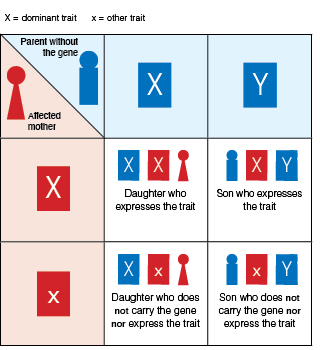
Depending on the disorder, a gene that is X-linked dominant may cause a pregnancy with a male not to survive. Scientists and doctors say that there is "lethality" in males. This means that the gene can be passed from mother to daughter, but if it is passed to a son, the pregnancy likely ends up as a miscarriage. Only those sons without the gene survive and are born healthy. One example of an X-linked dominant condition is called incontinentia pigmenti (IP).
What is incontinentia pigmenti?
IP is extremely rare. The main features occur in the skin. It is seen more often in females. In newborns, a blistering rash occurs. This is followed by the blisters becoming raised, like warts. Next, brown swirls appear in the skin. This is followed by the appearance of light-colored swirls. The result is a "marble-cake-like" appearance on the skin. Other health problems can be seen in IP involving the eyes, central nervous system, teeth, nails, and hair. The severity varies from person to person, even among affected people in the same family.
Featured in
Date Last Reviewed: 08/01/2025
© 2000-2026 The StayWell Company, LLC. All rights reserved. This information is not intended as a substitute for professional medical care. Always follow your healthcare professional's instructions.
Learn More About Health Services at PIH Health
Expert care for every stage of life. Explore the comprehensive services offered at PIH Health.
Explore Services
Get Health Tips & Updates
Sign up for helpful health information, wellness tips and news from PIH Health, delivered straight to your inbox.
SubscribeRelated Articles
When Your Child Has Immune Thrombocytopenia (ITP)
Immune Thrombocytopenia (ITP) is a blood disorder that affects the platelets. Platelets (also called thrombocytes) are blood cells that help with clotting. With ITP, there are not enough platelets. As a result, your child can have more bleeding or bruising than normal.
Fanconi Anemia in Children
Fanconi anemia is a blood disorder. With this condition, the bone marrow doesn't make enough blood cells. Or it makes abnormal blood cells.
Immune Thrombocytopenic Purpura in Children
ITP is a blood disorder that causes a decrease in the number of platelets in the blood. Platelets help stop bleeding. So a decrease in platelets can result in easy bruising, bleeding gums, and bleeding inside the body.
When Your Child Has Hyperthyroidism
Your child's thyroid gland is overactive and makes too much thyroid hormone. This means your child's thyroid gland makes too much thyroid hormone. Read on to learn how to care for your child.

Personalized Care Starts with the Right Provider
Search by specialty, location, and more.
Find A Doctor
Make an Appointment
Your health can't always wait. Schedule an appointment with a PIH Health provider.
Schedule an Appointment
Find a PIH Health Urgent Care Location
Need care today?. Find the nearest PIH Health Urgent Care location.
Find Urgent Care