A bursa is a thin, slippery, saclike film that contains a small amount of fluid. A bursa is often found in and around joints. It cushions and protects bones and soft tissues, and stops them from rubbing against each other. If a bursa becomes inflamed and irritated, it's known as bursitis.
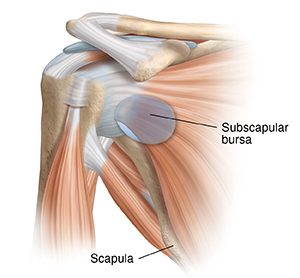
The subscapularis muscle is a large muscle across the front of the shoulder blade. The subscapular bursa is found between the subscapularis muscle and the chest wall. Inflammation of this bursa is called subscapular bursitis.
Causes of subscapular bursitis
These may include:
-
Overuse of the shoulder from things like reaching, lifting, and throwing.
-
Injury from a fall or other accident.
-
Having rheumatoid arthritis or other types of inflammatory arthritis.
Symptoms of subscapular bursitis
The shoulder may be painful or aching. This pain may be worse when raising your arm or lying on the affected shoulder.
Treatment for subscapular bursitis
These may include:
-
Resting your shoulder. This allows the bursa to heal.
-
Prescription or over-the-counter medicines. These can help reduce inflammation, pain, and swelling. NSAIDs (nonsteroidal anti-inflammatory drugs) are the most commonly used medicines. Medicines may be prescribed or bought over the counter. They may be given as pills. Or they may be put on the skin as a gel, cream, or patch.
-
Cold packs or heat packs. These can help reduce pain and swelling.
-
Exercises. These improve shoulder flexibility and strength.
-
Physical therapy. This may include exercises, education, and other treatments.
-
Injections of medicine into the bursa. This may help reduce inflammation and relieve symptoms. This usually is an anti-inflammatory medicine called a corticosteroid.
Possible complications
If your shoulder isn’t given time to heal, symptoms may return or get worse. Also, the problem may become long-term (chronic). This can lead to trouble moving the shoulder joint.
When to contact your doctor
Contact your health care provider right away if you have:
-
A fever of 100.4°F (38°C) or higher, or as directed by your provider.
-
Chills.
-
Symptoms that don’t get better with treatment, or that get worse.
-
New symptoms.
Author: Michels, Karen
Online Medical Reviewer: Raymond Turley Jr PA-C
Online Medical Reviewer: Stacey Wojcik MBA BSN RN
Online Medical Reviewer: Thomas N Joseph MD
Date Last Reviewed: 04/01/2025
© 2000-2026 The StayWell Company, LLC. All rights reserved. This information is not intended as a substitute for professional medical care. Always follow your healthcare professional's instructions.
Learn More About Health Services at PIH Health
Expert care for every stage of life. Explore the comprehensive services offered at PIH Health.
Explore Services
Get Health Tips & Updates
Sign up for helpful health information, wellness tips and news from PIH Health, delivered straight to your inbox.
SubscribeRelated Articles
Chest Bruise (Contusion)
A contusion is a bruise to the skin, muscle, or ribs. Read on to learn how to care for yourself at home.
Osteoporosis: Screening for Bone Loss
Bone density testing is safe, quick, easy, and painless. Testing can detect osteoporosis before a fracture happens. It can also predict the risk of future fractures. And testing can measure the response to treatment.
Fluid on the Knee
Fluid on the knee is also called knee effusion. Learn how to care for yourself at home as you heal.
Soft-Tissue Injuries
Detailed information on the most common types of soft-tissue injuries.

Personalized Care Starts with the Right Provider
Search by specialty, location, and more.
Find A Doctor
Make an Appointment
Your health can't always wait. Schedule an appointment with a PIH Health provider.
Schedule an Appointment
Find a PIH Health Urgent Care Location
Need care today?. Find the nearest PIH Health Urgent Care location.
Find Urgent Care