Scoliosis is a problem that makes the spine curve and twist from side to side. It's most often found in girls in their early teens. But boys can have it, too. No one is sure what causes scoliosis. But we do know that scoliosis is not caused by things like carrying heavy bags or playing sports. If someone in your family (like a parent or a sibling) has scoliosis, you may be more likely to have it, too.
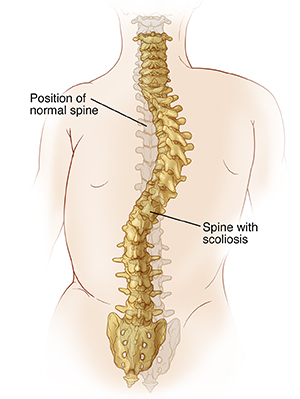
What are the signs?
The signs of scoliosis may include:
-
One shoulder higher than the other.
-
One shoulder blade sticking out farther than the other.
-
An uneven waistline.
-
One hip higher than the other.
-
Hems hanging unevenly on you.
-
One side of the rib cage higher than the other when bending forward.
These signs often appear slowly as you grow. You and your parents may not even notice them. For this reason, schools in many states have screening programs to check for scoliosis. These programs help find scoliosis early and keep it from causing problems later.
A note to parents
Here are some suggestions:
-
Hearing that your child has scoliosis can be upsetting. But remember that mild cases may not need treatment. If your child's scoliosis is severe or getting worse, it can be treated.
-
Go to all your child’s appointments. Ask questions and be sure you understand the health care provider’s instructions.
-
Become informed about scoliosis. Try the library or do a search on the internet.
-
Form a team with your child and their provider. Be your child’s coach and biggest fan.
-
Know that each child is different. Your child’s provider will choose the treatment that is best for your child’s spine.
Online Medical Reviewer: Marianne Fraser MSN RN
Online Medical Reviewer: Raymond Turley Jr PA-C
Online Medical Reviewer: Vinita Wadhawan Researcher
Date Last Reviewed: 01/01/2025
© 2000-2026 The StayWell Company, LLC. All rights reserved. This information is not intended as a substitute for professional medical care. Always follow your healthcare professional's instructions.
Learn More About Health Services at PIH Health
Expert care for every stage of life. Explore the comprehensive services offered at PIH Health.
Explore Services
Get Health Tips & Updates
Sign up for helpful health information, wellness tips and news from PIH Health, delivered straight to your inbox.
SubscribeRelated Articles
Fluid on the Knee
Fluid on the knee is also called knee effusion. Learn how to care for yourself at home as you heal.
Hip Dislocation
A hip dislocation happens when the femur pops out of its socket. Learn what kind of care is needed.
Open Toe Fracture
A toe fracture causes local pain, swelling, and bruising. A nearby open injury, such as a cut, puncture, or deep scrape, increases the risk of infection in the skin and bone. Antibiotics are used to lower the risk of infection.
Baker’s Cyst
You have a Baker's cyst. This is a lump in the back of your knee that is caused when extra joint fluid flows into a small sac behind the knee.
Personalized Care Starts with the Right Provider
Search by specialty, location, and more.
Find A Doctor
Make an Appointment
Your health can't always wait. Schedule an appointment with a PIH Health provider.
Schedule an Appointment
Find a PIH Health Urgent Care Location
Need care today?. Find the nearest PIH Health Urgent Care location.
Find Urgent Care