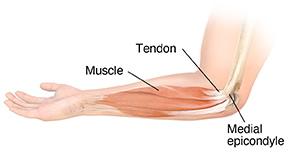
Several muscles attach to the arm at the elbow joint. The tough bands of tissue that attach muscle to bones are called tendons. The bone in the upper arm has knobs on the farthest end called epicondyles. Tendons attach some arm muscles to these knobs. The tissues in this area can become irritated.
Epicondylitis is the medical term for a painful, inflamed elbow over the epicondyle. Medial refers to the inner side of the elbow. Medial epicondylitis is sometimes called “golfer’s elbow.”
How to say it
MEE-dee-uhl eh-pih-KOHN-dih-li-tihs
Causes of medial epicondylitis
A painful inner elbow may be caused by:
-
Using an elbow or hand the same way over and over.
-
Using poor form or too much force in a sport such as golf, tennis, or baseball.
-
Lifting too heavy a weight.
-
Other injuries to the arm or elbow.
Symptoms of medial epicondylitis
-
Pain or tenderness on the inside of the elbow that may travel down the forearm
-
Pain when moving the wrist
-
Pain or weakness when gripping something
-
A crackling sound or grating feeling when moving the elbow
Treatment for medial epicondylitis
Treatments may include:
-
Preventing or changing the action that caused the problem. This helps prevent irritating the tissues more.
-
Prescription or over-the-counter medicines. These help reduce inflammation, swelling, and pain.
-
Braces. A counter-force brace can help reduce tendon strain. This allows the joint to heal.
-
Cold or heat packs. These help reduce pain and swelling.
-
Stretching and other exercises. These improve flexibility and strength.
-
Physical therapy. This may include exercises or other treatments.
-
Injections of medicine. This may relieve symptoms.
If other treatments don't relieve symptoms, you may need surgery.
Possible complications
If you don’t give your elbow time to heal, symptoms may return or get worse. Follow your health care provider’s instructions on resting and treating your elbow.
When to contact your doctor
Contact your provider right away if:
-
You have a fever of 100.4°F (38°C) or higher, or as directed by your provider.
-
Chills
-
The redness, swelling, or warmth gets worse.
-
Your symptoms don’t get better with prescribed medicines, or they get worse.
-
You have new symptoms.
Author: Freed. Becca
Online Medical Reviewer: Kenny Turley PA-C
Online Medical Reviewer: L Renee Watson MSN RN
Online Medical Reviewer: Raymond Kent Turley BSN MSN RN
Date Last Reviewed: 03/01/2025
© 2000-2026 The StayWell Company, LLC. All rights reserved. This information is not intended as a substitute for professional medical care. Always follow your healthcare professional's instructions.
Learn More About Health Services at PIH Health
Expert care for every stage of life. Explore the comprehensive services offered at PIH Health.
Explore Services
Get Health Tips & Updates
Sign up for helpful health information, wellness tips and news from PIH Health, delivered straight to your inbox.
SubscribeRelated Articles
Understanding a Clavicle Fracture
A fracture of the clavicle is a broken collarbone. Clavicle fractures occur most often along the middle of the bone. Depending on how badly the bone is broken, healing may take a few months or longer.
Understanding Dupuytren Contracture
Dupuytren contracture is a disease that can lead to limited use of your hand. While it often doesn't cause pain, it can make it hard to straighten your fingers. Learn about causes, symptoms, and treatment.
Understanding Shoulder Impingement Syndrome
Shoulder impingement syndrome is a problem with the shoulder joint. It occurs when certain parts in the joint swell and are pinched. This can cause nagging pain and problems with moving the arm.
Finger Dislocation
How to care for your finger after a dislocation.
Personalized Care Starts with the Right Provider
Search by specialty, location, and more.
Find A Doctor
Make an Appointment
Your health can't always wait. Schedule an appointment with a PIH Health provider.
Schedule an Appointment
Find a PIH Health Urgent Care Location
Need care today?. Find the nearest PIH Health Urgent Care location.
Find Urgent Care