Tendons are strong bands of tissue that connect muscles to bones. Lateral epicondylitis affects the tendons that connect muscles in the forearm to the lateral epicondyle. This is the bony knob on the outer side of the elbow. The condition occurs if the extensor tendons of the wrist become painful and swollen (irritated). This can cause pain in the elbow, forearm, and wrist. Because the condition is sometimes caused by playing tennis, it's also called tennis elbow.
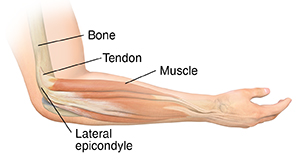
How to say it
LA-ter-uhl eh-pih-KAWN-duh-LI-tihs
What causes lateral epicondylitis?
The condition most often occurs because of overuse. This can be from any activity that repeatedly puts stress on the forearm extensor muscles or tendons and wrist. For instance, playing tennis, lifting weights, cutting meat, painting, and typing can all cause the condition. Wear and tear of the tendons from aging or an injury to the tendons can also cause the condition.
Symptoms of lateral epicondylitis
The most common symptom is pain. You may feel it on the outer side of the elbow and down the back of the forearm. It may be worse when moving or using the elbow, forearm, or wrist. You may also feel pain when gripping or lifting things.
Treatment for lateral epicondylitis
Treatments may include:
-
Resting the elbow, forearm, and wrist. You’ll need to avoid movements that can make your symptoms worse. You also may need to stay away from certain sports and types of work for a time. This helps relieve symptoms and prevent further damage to the tendons.
-
Changing the action that caused the problem. For instance, if the tendons were damaged from playing tennis, it may help to change your playing method or use different equipment. This helps prevent further damage to the tendons.
-
Using cold packs. Putting an ice pack on the injured area can help reduce pain and swelling.
-
Taking pain medicines. Taking prescription or over-the-counter pain medicines may help reduce pain and swelling. They may be given as pills. Or they may be put on the skin as a gel, cream, or patch.
-
Wearing a brace. This helps reduce strain on the muscles and tendons in the forearm, which may relieve symptoms. It's very important to wear the brace correctly.
-
Doing exercises and physical therapy. These help improve strength and range of motion in the elbow, forearm, and wrist.
-
Getting shots of medicine into the injured area. These may help relieve symptoms for a time.
-
Having surgery. This may be a choice if other treatments fail to relieve symptoms. In many cases, the surgeon removes the damaged tissue.
Possible complications of lateral epicondylitis
If the tendons affected don’t heal correctly, symptoms may return or get worse. To help prevent this, follow your treatment plan as directed.
When to call your healthcare provider
Call your healthcare provider right away if you have any of these:
-
Fever of 100.4°F (38°C) or higher, or as advised by your provider
-
Chills
-
Redness, swelling, or warmth in the elbow or forearm that gets worse
-
Symptoms that don’t get better with treatment, or get worse
-
New symptoms
Author: Yang, Sue
Online Medical Reviewer: Raymond Turley Jr PA-C
Online Medical Reviewer: Stacey Wojcik MBA BSN RN
Online Medical Reviewer: Thomas N Joseph MD
Date Last Reviewed: 04/01/2024
© 2000-2026 The StayWell Company, LLC. All rights reserved. This information is not intended as a substitute for professional medical care. Always follow your healthcare professional's instructions.
Learn More About Health Services at PIH Health
Expert care for every stage of life. Explore the comprehensive services offered at PIH Health.
Explore Services
Get Health Tips & Updates
Sign up for helpful health information, wellness tips and news from PIH Health, delivered straight to your inbox.
SubscribeRelated Articles
Hip Dislocation
A hip dislocation happens when the femur pops out of its socket. Learn what kind of care is needed.
Open Toe Fracture
A toe fracture causes local pain, swelling, and bruising. A nearby open injury, such as a cut, puncture, or deep scrape, increases the risk of infection in the skin and bone. Antibiotics are used to lower the risk of infection.
Baker’s Cyst
You have a Baker's cyst. This is a lump in the back of your knee that is caused when extra joint fluid flows into a small sac behind the knee.
Fluid on the Knee
Fluid on the knee is also called knee effusion. Learn how to care for yourself at home as you heal.
Personalized Care Starts with the Right Provider
Search by specialty, location, and more.
Find A Doctor
Make an Appointment
Your health can't always wait. Schedule an appointment with a PIH Health provider.
Schedule an Appointment
Find a PIH Health Urgent Care Location
Need care today?. Find the nearest PIH Health Urgent Care location.
Find Urgent Care