Iliotibial (IT) band syndrome is a condition that causes pain on the outside of the knee. It most often occurs in athletes, especially long-distance runners. It can also happen if you cycle, ski, row, or play soccer. It can also occur in people who are just starting to exercise.
What is the IT band?
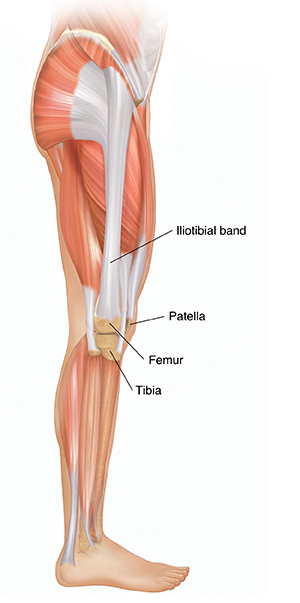
The iliotibial (IT) band is a strong, thick band of tissue that runs down the outside of your thigh. It goes all the way from your hipbones to the top of your shinbone (tibia), just below your knee joint. The bones of your knee joint include your tibia, your thighbone (femur), and your kneecap (patella).
When you bend and straighten your leg, the IT band moves over the outer lower edge of your femur. Over time, bending and straightening your leg can cause the IT band to irritate nearby tissues and cause pain.
What causes IT band syndrome?
Researchers are still learning the exact cause of IT band syndrome. The pain may be caused by the IT band rubbing over the lower outer edge of the femur. This may cause inflammation in the bone, tendons, and small fluid-filled sacs (bursa) in the area. The IT band may also squeeze (compress) the tissue under it and cause pain.
If you are a runner, you might be more likely to develop IT band syndrome if:
-
You run on uneven ground or down hills.
-
You run in worn-out shoes.
-
You run many miles a day.
-
Your legs bend in a little from your knee to your ankle (bowlegs).
What are the symptoms?
IT band syndrome causes pain on the outside of the knee or side of the thigh. It might affect one or both of your knees. The pain is an aching, burning feeling that can spread up the thigh to the hip. You may feel this pain only when you exercise, such as while running. The pain may be the worst right after you step on your foot. It may only happen near the end of your exercise. As the condition gets worse, pain may start earlier. It may continue after you stop exercising. Going up and down stairs may make the pain worse.
How is IT band syndrome diagnosed?
Your doctor will ask about your health history and your symptoms. They will give you a physical exam. This will include an exam of your knee. The range of motion and strength of your knee will be tested. The doctor will look for areas of pain around your knee, thigh, and hip. The symptoms of IT band syndrome can be like those of osteoarthritis or a meniscal tear. Your doctor will make sure IT band syndrome is the cause of your symptoms. If the diagnosis is not clear, you may need imaging tests. These can include an X-ray or MRI scan.
Online Medical Reviewer: Kenny Turley PA-C
Online Medical Reviewer: L Renee Watson MSN RN
Online Medical Reviewer: Thomas N Joseph MD
Date Last Reviewed: 05/01/2025
© 2000-2026 The StayWell Company, LLC. All rights reserved. This information is not intended as a substitute for professional medical care. Always follow your healthcare professional's instructions.
Learn More About Health Services at PIH Health
Expert care for every stage of life. Explore the comprehensive services offered at PIH Health.
Explore Services
Get Health Tips & Updates
Sign up for helpful health information, wellness tips and news from PIH Health, delivered straight to your inbox.
SubscribeRelated Articles
Finger Dislocation
How to care for your finger after a dislocation.
Understanding Neck Problems
Problems, such as poor posture, injury, and wear and tear, can lead to neck pain.
Compression Fracture
A compression fracture is a type of break in the bones in your back that stack up to form your spine. A compression fracture can cause back pain, limited movement, a decrease in height, and a stopped over posture. It often develops as a result of osteoporosis.
Understanding a Humerus Fracture
When you have a humerus fracture, it means that your upper arm bone is broken. Depending on the severity of the fracture, healing may take several months or longer.

Personalized Care Starts with the Right Provider
Search by specialty, location, and more.
Find A Doctor
Make an Appointment
Your health can't always wait. Schedule an appointment with a PIH Health provider.
Schedule an Appointment
Find a PIH Health Urgent Care Location
Need care today?. Find the nearest PIH Health Urgent Care location.
Find Urgent Care