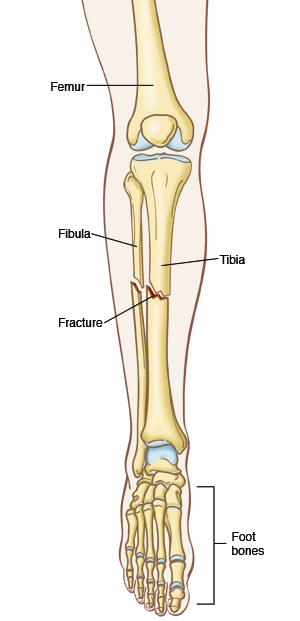
You have a break (fracture) of the leg. A fracture can be treated with a splint, cast, or special boot. If the fracture is displaced, it will likely require surgery. It will usually take about 8 to 12 weeks for the fracture to heal, but it can take longer in some cases. If you have a severe injury, you may need surgery to fix it.
Home care
Follow these guidelines when caring for yourself at home:
-
You will be given a splint, cast, boot, or other device to keep the injured area from moving. Unless you were told otherwise, use crutches or a walker. Don’t put weight on the injured leg until your health care provider says you can do so. (You can rent crutches and a walker at many pharmacies and surgical or orthopedic supply stores.)
-
Keep your leg elevated (raised) to reduce pain and swelling. When sleeping, put a pillow under the injured leg. When sitting, support the injured leg so it's above your heart. This is very important during the first 2 days (48 hours).
-
Put an ice pack on the injured area. Do this for 20 minutes every 1 to 2 hours the first day for pain relief. You can make an ice pack by wrapping a plastic bag of ice cubes in a thin towel. As the ice melts, be careful that the cast, splint, or boot doesn’t get wet. You can put the ice pack directly over the splint or cast. Continue using the ice pack 3 to 4 times a day for the next 2 days. Then use the ice pack as needed to ease pain and swelling.
-
Keep the cast, splint, or boot completely dry at all times. Bathe with your cast, splint, or boot out of the water. Protect it with 2 layers of plastic, such as 2 plastic bags, rubber-banded or taped at the top end. Or use a waterproof shield. If a boot or fiberglass cast or splint gets wet, you can dry it with a hair dryer on the cool setting.
-
You may use acetaminophen or ibuprofen to control pain, unless another pain medicine was prescribed. If you have chronic liver or kidney disease, talk with your provider before using these medicines. Also talk with your provider if you’ve had a stomach ulcer or gastrointestinal bleeding, or if you take a blood thinner.
-
Don’t put creams or objects under the cast if you have itching.
Follow-up care
Follow up with your health care provider as advised. This is to make sure the bone is healing the way it should. If a splint was put on, it may be converted to a cast at your next visit.
X-rays may be taken. You will be told of any new findings that may affect your care.
When to get medical advice
Contact your health care provider right away if any of the following occur:
-
The cast or splint cracks
-
The plaster cast or splint becomes wet or soft
-
The fiberglass cast or splint stays wet for more than 24 hours
-
Bad odor from the cast or wound fluid stains the cast
-
Tightness or pain under the cast or splint gets worse
-
Toes become swollen, cold, blue, numb, or tingly
-
You can’t move your toes
-
Skin around cast or splint becomes red or irritated
-
Fever of 100.4ºF (38ºC) or higher, or as directed by your provider
-
Shaking chills
Online Medical Reviewer: Raymond Turley Jr PA-C
Online Medical Reviewer: Stacey Wojcik MBA BSN RN
Online Medical Reviewer: Thomas N Joseph MD
Date Last Reviewed: 03/01/2025
© 2000-2026 The StayWell Company, LLC. All rights reserved. This information is not intended as a substitute for professional medical care. Always follow your healthcare professional's instructions.
Learn More About Health Services at PIH Health
Expert care for every stage of life. Explore the comprehensive services offered at PIH Health.
Explore Services
Get Health Tips & Updates
Sign up for helpful health information, wellness tips and news from PIH Health, delivered straight to your inbox.
SubscribeRelated Articles
Transverse process fracture
You have fractured a transverse process. You have 2 transverse processes that extend off each vertebra, 1 on each side. This is where the muscles and ligaments of the back attach to the spine.
Understanding Shoulder Instability
The leading cause of instability is an injury that forces the humeral head out of its socket. If the humerus pushes completely out of the joint, it's called dislocation. If it only pushes partway out, it's called subluxation.
Coccyx or Sacrum Bruise (Contusion)
A contusion of the coccyx or sacrum causes swelling and some bleeding under the skin. This injury generally takes a few weeks to heal. Read on for details about how to care for yourself.
Open Toe Fracture
A toe fracture causes local pain, swelling, and bruising. A nearby open injury, such as a cut, puncture, or deep scrape, increases the risk of infection in the skin and bone. Antibiotics are used to lower the risk of infection.

Personalized Care Starts with the Right Provider
Search by specialty, location, and more.
Find A Doctor
Make an Appointment
Your health can't always wait. Schedule an appointment with a PIH Health provider.
Schedule an Appointment
Find a PIH Health Urgent Care Location
Need care today?. Find the nearest PIH Health Urgent Care location.
Find Urgent Care