A sprain is a tearing of the ligaments that hold a joint together. This may take up to 6 weeks or more to fully heal, depending on how severe it is. Moderate to severe sprains are treated with a sling or splint. Minor sprains can be treated without any special support.
Home care
The following guidelines will help you care for your injury at home:
-
Keep your arm elevated to reduce pain and swelling. When sitting or lying down, keep your arm above the level of your heart. You can do this by placing your arm on a pillow that rests on your chest or on a pillow at your side. This is most important during the first 2 days (48 hours) after injury.
-
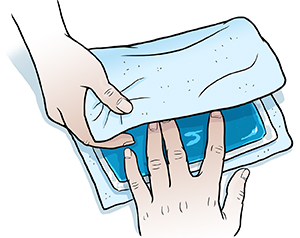
Put an ice pack on the injured area. Do this for 20 minutes every 1 to 2 hours the first day. You can make an ice pack by wrapping a plastic bag of ice cubes in a thin towel. As the ice melts, be careful that the splint doesn’t get wet. Continue using the ice pack 3 to 4 times a day for the next 2 days. Then use the ice pack as needed to ease pain and swelling.
-
If you were given a plaster or fiberglass splint, leave it on as advised, or until you see your healthcare provider. Keep it dry at all times. Bathe with your splint out of the water. Protect it with a large plastic bag, rubber-banded, or taped at the top end. If a fiberglass splint gets wet, you can dry it with a hair dryer. Once the splint is removed, move your elbow through its full range of motion several times a day as directed. This will prevent stiffness.
-
If you were given a sling only, start gradual range-of-motion exercises after the first few days, unless told otherwise. This will prevent stiffness in the elbow. Stop wearing the sling once the pain is better.
-
You may use acetaminophen or ibuprofen to control pain, unless another pain medicine was prescribed. If you have chronic liver or kidney disease, talk with your healthcare provider before using these medicines. Also talk with your provider if you’ve had a stomach ulcer, have digestive bleeding, or take blood thinners.
Follow-up care
Follow up with your healthcare provider as directed.
Any X-rays you had today don’t show any broken bones, breaks, or fractures. Sometimes fractures don’t show up on the first X-ray. Bruises and sprains can sometimes hurt as much as a fracture. These injuries can take time to heal completely. If your symptoms don’t improve or they get worse, talk with your provider. You may need repeat X-rays or other tests.
When to get medical advice
Call your healthcare provider right away if any of these occur:
-
The plaster splint becomes wet or soft
-
The fiberglass splint remains wet for more than 24 hours
-
Bad odor from the splint or wound fluid stains the splint
-
Splint cracks
-
Tightness or pain in the elbow gets worse
-
Fingers become swollen, cold, blue, numb, or tingly
-
You are less able to move the elbow, hand, or fingers
-
Area around splint becomes red, swollen, or irritated
-
Fever of 100.4ºF (38ºC) or higher, as advised by your provider
-
Chills
Online Medical Reviewer: Raymond Turley Jr PA-C
Online Medical Reviewer: Stacey Wojcik MBA BSN RN
Online Medical Reviewer: Thomas N Joseph MD
Date Last Reviewed: 08/01/2022
© 2000-2026 The StayWell Company, LLC. All rights reserved. This information is not intended as a substitute for professional medical care. Always follow your healthcare professional's instructions.
Learn More About Health Services at PIH Health
Expert care for every stage of life. Explore the comprehensive services offered at PIH Health.
Explore Services
Get Health Tips & Updates
Sign up for helpful health information, wellness tips and news from PIH Health, delivered straight to your inbox.
SubscribeRelated Articles
Knee Sprain of the Collateral Ligaments
You have a knee sprain. A sprain is a tearing of a ligament. Learn how to take care of a knee sprain at home.
Pinched Nerve in the Neck
Pinched nerve in the neck (cervical radiculopathy) is caused when the nerve that goes from the spinal cord to the arm is irritated or has pressure on it. This may be caused by a bulging spinal disk or a narrowing of the spinal joint because of arthritis.
Sacroiliitis
Sacroiliitis is when one or both sacroiliac joints are hurt or inflamed. It can make small movements of the lower back and pelvis very painful. Learn how to care for yourself at home.
Sciatica
Sciatica is a condition that causes pain in the low back and down into the buttock, hip, and leg. Read on to learn more about this condition, along with helpful tips to care for yourself at home.

Personalized Care Starts with the Right Provider
Search by specialty, location, and more.
Find A Doctor
Make an Appointment
Your health can't always wait. Schedule an appointment with a PIH Health provider.
Schedule an Appointment
Find a PIH Health Urgent Care Location
Need care today?. Find the nearest PIH Health Urgent Care location.
Find Urgent Care