The spinal cord is part of the central nervous system. It relays sensations to the brain and allows the brain to control movements and function of the internal organs, trunk, and arms and legs. The spinal cord is made up of bundles of nerve cells and fibers. The spinal cord carries signals from your body to your brain, and vice versa.
The spinal cord is tube-shaped and extends from the brain all the way down to the top of the lumbar spine, or the lower region of the spine. Branching off from the spinal cord are sensory and motor nerves called nerve roots. These roots come out from small spaces between the bones (vertebrae) that surround the spinal cord and run to different parts of the body.
The entire spinal cord is surrounded by a liquid called cerebrospinal fluid, or CSF. CSF protects the spinal cord from injury. It's contained within the meninges. These are three protective layers that surround the spinal cord. These three layers are the dura mater, the arachnoid mater, and the pia mater.
The spinal cord and spine are divided into 4 regions from top to bottom: cervical, thoracic, lumbar, and sacral. Damage to the nerve fibers in the spinal cord can result in many health conditions, depending on the region that is affected.
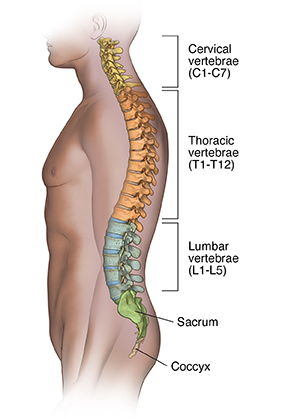
Cervical region
This portion of the spinal cord contains nerve roots that connect to the upper body, arms, and hands. Nerves going to and coming from the lower parts of the body have to pass through the cervical spinal cord. These nerves are bundled into tracts. Between the vertebrae in the spine are spongy cushions called intervertebral disks. If the disks bulge (herniate), they may squeeze (pinch) the spinal cord or nerve roots. This can lead to conditions called cervical myelopathy and cervical radiculopathy. These conditions can cause pain, weakness, or numbness in the arms. If the cervical region is severely injured, such as when the spinal cord is injured, most of the body can be paralyzed (quadriplegia). This can also lead to loss of control of some organs, such as bowel and bladder control. Severe injuries can occur from a fall or from certain health conditions. Another common condition is spinal stenosis. It's usually associated with aging, and bony and ligament overgrowth. All of this leads to the spinal canal becoming narrow. The spinal cord and nerve roots then become slowly pinched. This causes pain, changed sensation, and loss of motor ability in the arms and legs
Thoracic region
The nerve roots in the thoracic spinal cord run to the chest and stomach and control movement in those parts of the body. Serious injuries to the thoracic region of the spinal cord can lead to paraplegia. This is paralysis of the lower part of the body and loss of bladder control.
Lumbar region
The lumbar spinal cord is the lower area of the back. Nerve roots coming from the spinal cord in the lumbar spine control the legs. The lumbar region is where the spinal cord ends (the spinal cord is shorter than the spine). After the lumbar spinal cord ends, it continues as a bundle of nerve roots in the lower back (the cauda equina). An intervertebral disk in the lumbar spine may herniate or move into the space containing a nerve root. This can cause lower back pain or lower extremity pain (lumbar radiculopathy or sciatica). In severe cases, it can cause cauda equina syndrome. This is a serious condition that compresses all of the sacral nerve roots. This causes inability to empty the bladder (urinary retention), constipation, loss of feeling in the groin (saddle anesthesia), and weakness or paralysis of the legs or feet.
Sacral region
The lowest part of the spinal nerve roots contains 5 pairs of nerves. These control the thighs, lower legs, and the genital and anal areas. Sacral nerve injury can happen anywhere from the upper lumbar spine down to the sacrum. This can lead to lower back pain, urinary incontinence or retention, loss of feeling in the foot, and sexual dysfunction.
Keeping your spinal cord healthy
Some spinal cord injuries can’t always be prevented, such as those caused by car accidents. But you can take many steps to preserve the health of your spine and the spinal cord nerves within it. Car crash injuries may be reduced by correctly using seat belts and air bags. Staying at or reaching a healthy weight is suggested because excess pounds can put unneeded stress on your back. It's also important to maintain good posture, stretch, and take part in physical activities that strengthen your abdominal and back muscles. To strengthen the bones of your spine and protect your spinal cord, a vitamin D-rich diet is also essential. If you have osteoporosis, ask your health care provider how it should be treated. Finally, know your limits and don't pick up items that are too heavy for you to lift safely. Use correct lifting methods.
Date Last Reviewed: 04/01/2025
© 2000-2026 The StayWell Company, LLC. All rights reserved. This information is not intended as a substitute for professional medical care. Always follow your healthcare professional's instructions.
Learn More About Health Services at PIH Health
Expert care for every stage of life. Explore the comprehensive services offered at PIH Health.
Explore Services
Get Health Tips & Updates
Sign up for helpful health information, wellness tips and news from PIH Health, delivered straight to your inbox.
SubscribeRelated Articles
Parts of a Hand
Hands are made up of more bones and moving parts than most other areas of the body. Learn more, along with helpful diagrams.
Facial Fracture
You have a broken bone, or fracture, in your face. This may be a small crack in the bone. Or it may be a major break, with the bone moved out of place.
Anatomy of the Male and Female Pelvis
The pelvis is a basin-shaped structure that supports the spinal column and protects the abdominal organs.
Understanding Therapeutic Plasma Exchange (TPE)
Therapeutic plasma exchange (TPE) is a treatment that removes plasma from your blood. The removed plasma is then replaced with a substitute to help ease symptoms of disease.

Personalized Care Starts with the Right Provider
Search by specialty, location, and more.
Find A Doctor
Make an Appointment
Your health can't always wait. Schedule an appointment with a PIH Health provider.
Schedule an Appointment
Find a PIH Health Urgent Care Location
Need care today?. Find the nearest PIH Health Urgent Care location.
Find Urgent Care