Blood sugar is the amount of sugar in the blood. The body needs sugar to function. Blood sugar must stay in a certain range for the body to be healthy. A body chemical (hormone) called insulin helps the body maintain a normal blood sugar level. In some newborns, blood sugar may be either too high or too low. So, doctors will carefully watch your baby’s blood sugar level in the neonatal intensive care unit (NICU). If your baby's blood sugar is too high or too low, treatment will bring it back under control.
Why is my baby’s blood sugar abnormal?
-
Low blood sugar is common in many babies right after birth. The baby’s body is getting used to controlling its blood sugar level without help from the mother’s body.
-
Mothers with diabetes have babies who are more likely to have low blood sugar. Babies who are either larger or smaller than the normal range for their age may also have low blood sugar.
-
High blood sugar can be caused by illness or stress. It’s also common in preemies born very early. That's because the organ that makes insulin (pancreas) is not fully developed.
How is blood sugar monitored?
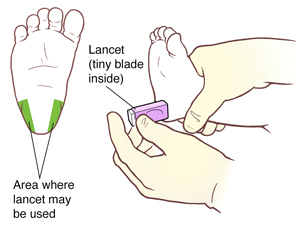
A doctor uses a tiny blade (lancet) to take a drop of blood from your baby’s foot. The blood is put on a small test strip. This measures the sugar in the drop of blood.
How are blood sugar problems treated?
-
If blood sugar is too low, you may feed your baby more often. The natural sugar in your milk or in formula helps raise blood sugar level. A doctor may also give your baby supplemental sugar (glucose) through a special gel by mouth, or by an I.V. (intravenous) line. In rare cases, some babies in intensive care may need medicine to keep their blood sugar level up.
-
If blood sugar is too high, a doctor may give your baby insulin. This helps the baby's body use up more of the sugar in the blood. If the baby is being fed through an I.V., a doctor may also lower the amount of glucose in the I.V. fluid. But babies need some sugar to grow and develop as they should. They can't have all the glucose removed from their feeds.
Does my baby have diabetes?
In adults, blood sugar problems are often caused by diabetes. If a mother has diabetes, her baby is more likely to have short-term (temporary) low blood sugar at birth. The problem continues until the baby’s pancreas adjusts to their normal blood sugar level. But the blood sugar problem your baby has does not mean your baby has diabetes. If your baby has low or high blood sugar as a newborn, it doesn't mean your baby is likely to grow up to have diabetes, either.
Featured in
Online Medical Reviewer: Donna Freeborn PhD CNM FNP
Online Medical Reviewer: Heather M Trevino BSN RNC
Online Medical Reviewer: Liora C Adler MD
Date Last Reviewed: 04/01/2025
© 2000-2026 The StayWell Company, LLC. All rights reserved. This information is not intended as a substitute for professional medical care. Always follow your healthcare professional's instructions.
Learn More About Health Services at PIH Health
Expert care for every stage of life. Explore the comprehensive services offered at PIH Health.
Explore Services
Get Health Tips & Updates
Sign up for helpful health information, wellness tips and news from PIH Health, delivered straight to your inbox.
SubscribeRelated Articles
Meconium Aspiration Syndrome in the Newborn
Meconium is the sticky stool in the intestine at birth. When it gets into a baby’s lungs, the airways in the lungs become swollen. Here's what you need to know.
Hydrops Fetalis
Hydrops fetalis is severe swelling (edema) in an unborn baby or a newborn baby. It is a life-threatening problem.
When Your Child Has a Broken Collarbone (Clavicular Fracture) at Birth
Your newborn has a broken collarbone (clavicle). This is a common and treatable problem in newborns. The clavicle almost always heals with no problems.
Hypocalcemia in the Newborn
Hypocalcemia is when a person doesn't have enough calcium in the blood. In babies, it’s called neonatal hypocalcemia. Your baby can get it at different times and from different causes.

Personalized Care Starts with the Right Provider
Search by specialty, location, and more.
Find A Doctor
Make an Appointment
Your health can't always wait. Schedule an appointment with a PIH Health provider.
Schedule an Appointment
Find a PIH Health Urgent Care Location
Need care today?. Find the nearest PIH Health Urgent Care location.
Find Urgent Care