Amniocentesis is a prenatal test that helps you learn if your baby has genetic problems. The test is most often done between 15 and 20 weeks of pregnancy. Talk with your doctor to see if this test is right for you.
Should you have amniocentesis?
You may want to think about having an amniocentesis if:
- You're age 35 or older.
- There's a history of inherited (genetic) problems in your family.
- You have another child with a genetic problem.
- An ultrasound or blood test has shown that the baby may have a birth defect or other health problem.
How is amniocentesis done?
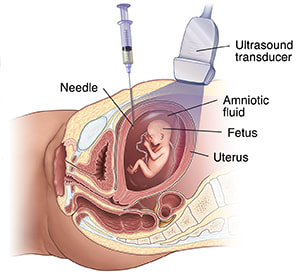
- The baby is located with ultrasound (sound waves that make an image on a screen).
- The belly is cleaned with a special soap or solution.
- A thin needle is put into your uterus, through your belly. The doctor keeps the needle from touching the baby by watching the screen.
- The needle is used to remove a small amount of amniotic fluid from your uterus. Your body will make more fluid to replace what was taken.
- You can go home right after the test. But you may need to take it easy for a day or so.
What are the possible risks?
This test is considered safe. But there are some possible risks. These include:
- Cramping, spotting, or leaking amniotic fluid.
- Infection in the uterus.
- Pregnancy loss (miscarriage). This is rare.
- The needle coming into contact with the baby. This is rare.
When to contact your doctor
Contact your doctor right away if you have:
- Severe pain or cramping.
- Vaginal bleeding (spotting).
- Fever or chills.
- Fluid leaking from your vagina.
Getting test results
You'll get your test results in about 2 weeks. Most results are normal. Even if yours aren't, it doesn't always mean there's a problem. But this will depend on what your doctor is looking for with amniocentesis. You and your doctor can talk about other tests or special care you may want.
Online Medical Reviewer: Donna Freeborn PhD CNM FNP
Online Medical Reviewer: Heather M Trevino BSN RNC
Online Medical Reviewer: Irina Burd MD PhD
Date Last Reviewed: 07/01/2022
© 2000-2026 The StayWell Company, LLC. All rights reserved. This information is not intended as a substitute for professional medical care. Always follow your healthcare professional's instructions.
Learn More About Health Services at PIH Health
Expert care for every stage of life. Explore the comprehensive services offered at PIH Health.
Explore Services
Get Health Tips & Updates
Sign up for helpful health information, wellness tips and news from PIH Health, delivered straight to your inbox.
SubscribeRelated Articles
Amniocentesis
Amniocentesis is a procedure used to take out a small sample of the amniotic fluid for testing.
Fetal Ultrasound
Fetal ultrasound is a test used during pregnancy to create an image of the baby in the uterus. Read on to learn more.
Understanding Fetal Echocardiography
Fetal echocardiography is a tyest that shows pictures of the baby's heart before birth. It is done to check for problems in the baby's heart structure, function, or rhythm.
Understanding a Multiple Pregnancy
A multiple pregnancy is usually found early in the pregnancy so that good prenatal care can begin. Read on to learn more.

Personalized Care Starts with the Right Provider
Search by specialty, location, and more.
Find A Doctor
Make an Appointment
Your health can't always wait. Schedule an appointment with a PIH Health provider.
Schedule an Appointment
Find a PIH Health Urgent Care Location
Need care today?. Find the nearest PIH Health Urgent Care location.
Find Urgent Care