A thoracotomy is surgery to open the chest wall. It may be done to treat a collapsed lung or to remove a tumor or mass from within the chest wall. Your hospital stay after a thoracotomy may be 3 to 4 days. Ask your care team how long you may need to stay in the hospital.
Right after surgery
You will wake up in a special monitoring unit. When you first wake up from the anesthesia, you may feel groggy, thirsty, or cold. If the breathing tube given to you during surgery remains in place, you won’t be able to talk. Monitors record your heartbeat and how much oxygen is in your blood.
Flexible tubes in your chest drain air, blood, and fluid. An I.V. (intravenous) line placed in your arm, hand, or neck gives you fluid and medicines.
A tube may be placed in your bladder to drain your urine. These tubes are usually removed when they are no longer needed, before you go home.
You may spend one or more days in this unit before you’re moved to your hospital room.
Managing your pain
As soon as you’re able, a nurse or physical therapist (PT) will help you begin to move around. This is to help improve your muscle strength and blood flow. You’ll be asked to sit up and walk. You can get pain medicines to help control pain as you move. A nurse may give you these medicines. Or you may have a special pump called a PCA (patient-controlled analgesia). This lets you give yourself pain medicine as you need it.
You may have had an epidural before surgery. If so, it may stay in place for a few days to give you more pain relief.
Respiratory therapy
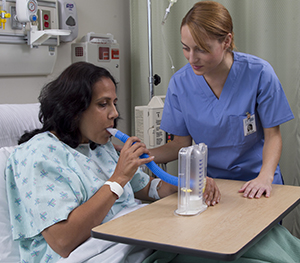
Soon after surgery, a nurse or respiratory therapist will teach you breathing exercises. These help keep your lungs clear. They also make your breathing muscles stronger and help prevent problems such as pneumonia. The exercises include incentive spirometry. You’ll put your mouth around a plastic device and breathe in as much air as you can. You will also be taught coughing exercises, deep-breathing exercises, and other breathing exercises to do on your own.
Range-of-motion exercises
A nurse or PT may teach you range-of-motion exercises. These exercises help stretch and strengthen the muscles on the side where you had surgery. They can help keep your shoulder moving freely. You may also be taught exercises to do at home as you heal.
Going home
Before you go home, your healthcare provider will review the results of your surgery with you. They can also tell you what to expect as you recover. If you need more treatment, you and your healthcare provider will discuss this. You will also review the next stage of your treatment plan and schedule follow-up visits. You will be given a list and prescriptions for your medicines after the surgery. These are often different from the medicines before the surgery. When you’re ready to go home, have a family member or friend drive you.
Online Medical Reviewer: Mary Mancini MD
Online Medical Reviewer: Ronald Karlin MD
Online Medical Reviewer: Stacey Wojcik MBA BSN RN
Date Last Reviewed: 02/01/2025
© 2000-2026 The StayWell Company, LLC. All rights reserved. This information is not intended as a substitute for professional medical care. Always follow your healthcare professional's instructions.
Learn More About Health Services at PIH Health
Expert care for every stage of life. Explore the comprehensive services offered at PIH Health.
Explore Services
Get Health Tips & Updates
Sign up for helpful health information, wellness tips and news from PIH Health, delivered straight to your inbox.
SubscribeRelated Articles
Thoracoscopy
Thoracoscopy is also called video-assisted thoracoscopy surgery. It's often used to repair a collapsed lung. It's also used to examine, biopsy, and stage a mass in the lung.
Before Minimally Invasive Heart Surgery
On the day of your bypass or valve surgery, a patient educator or a nurse may talk with you and your loved ones. You may be told what to expect.
Robot-Assisted Cardiac Surgery
Robotic cardiac surgery is a less invasive form of heart surgery. It's done using very small incisions in the chest, tiny tools, and a robotic device operated by a surgeon. Learn what to expect before, during, and after this procedure.
Pulmonary Artery Catheterization
Pulmonary artery catheterization is a procedure in which a long, thin tube called a catheter is inserted into a pulmonary artery. It can help diagnose and manage many health problems.

Personalized Care Starts with the Right Provider
Search by specialty, location, and more.
Find A Doctor
Make an Appointment
Your health can't always wait. Schedule an appointment with a PIH Health provider.
Schedule an Appointment
Find a PIH Health Urgent Care Location
Need care today?. Find the nearest PIH Health Urgent Care location.
Find Urgent Care