Peripheral angiography is a test that uses X-ray and dye (contrast material) to map the blood vessels (arteries) in your lower body, legs, and arms. This map can show where blood flow may be blocked.
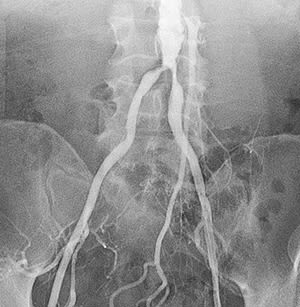
Talk with your doctor about the risks and possible complications of angiography.
Before the test
Get ready for the peripheral angiography as follows:
- Tell your doctor about all medicines you take. This includes prescription and over-the-counter medicines. It also includes vitamins, herbs, and other supplements.
- Tell your doctor about any allergies you may have.
- Follow any directions you're given for not eating or drinking before the test. If your doctor says to take your normal medicines, swallow them with only small sips of water.
- Arrange for a family member or friend to drive you home.
During the test
Here is what to expect:
- You may get medicine through an I.V. (intravenous) line to relax you. You're given an injection to numb the insertion site. Then, a tiny skin cut (incision) is made near an artery. This is usually in your wrist or groin, depending on what your doctor thinks is safest for you. The wrist is used more often now because it heals faster and has less risk of bleeding.
- Your doctor inserts a thin tube (catheter) through the incision. They then thread the catheter into an artery while looking at a video screen.
- Contrast dye is injected into the catheter to confirm position. You may feel warmth or pressure in your legs and back. You lie still as X-rays are taken. The catheter is then taken out.
After the test
You'll be taken to a recovery area. A doctor will apply pressure to the site for about 10 minutes. If the access was in your groin, you will need to lie flat for several hours. If it was in your wrist, you may be able to sit up sooner. Your doctor will tell you what to do.They will discuss the results with you soon after the test.
Back at home
On the day you get home, don't drive, exercise, walk, or use stairs. Don't bend or lift anything. Your doctor may give you additional care instructions.
When to contact your doctor
Contact your doctor right away if:
- You notice a lump or bleeding at the insertion site, but you can control it with firm pressure.
- You feel pain at the insertion site.
- You don't urinate in 8 hours.
Call 911
Call
- Notice a lump or bleeding at the insertion site, and you can't control it with firm pressure.
- Become lightheaded or dizzy.
- Have leg pain or numbness, or your leg becomes cold or blue.
Online Medical Reviewer: Chris Southard RN
Online Medical Reviewer: Marianne Fraser MSN RN
Online Medical Reviewer: Melinda Murray Ratini DO
Date Last Reviewed: 03/01/2024
© 2000-2026 The StayWell Company, LLC. All rights reserved. This information is not intended as a substitute for professional medical care. Always follow your healthcare professional's instructions.
Learn More About Health Services at PIH Health
Expert care for every stage of life. Explore the comprehensive services offered at PIH Health.
Explore Services
Get Health Tips & Updates
Sign up for helpful health information, wellness tips and news from PIH Health, delivered straight to your inbox.
SubscribeRelated Articles
Surgery for Abdominal Aortic Aneurysm
During surgery for abdominal aortic aneurysm, the weakened aortic wall is replaced with a hollow man-made tube (a graft).
Understanding Embolectomy
Embolectomy is surgery to remove a blood clot (embolus) from one of your blood vessels. It is often an emergency procedure.
Having Inferior Vena Cava (IVC) Filter Placement and Removal
An inferior vena cava (IVC) filter is a small device that can stop blood clots from going into your lungs.
Endovascular Repair of an Abdominal Aortic Aneurysm (AAA)
Endovascular repair is a type of treatment for an abdominal aortic aneurysm, or AAA. This is a bulge in the wall of the large artery below your heart that is at risk for rupture. During the procedure, the weak section of the aorta is treated to prevent it from tearing.

Personalized Care Starts with the Right Provider
Search by specialty, location, and more.
Find A Doctor
Make an Appointment
Your health can't always wait. Schedule an appointment with a PIH Health provider.
Schedule an Appointment
Find a PIH Health Urgent Care Location
Need care today?. Find the nearest PIH Health Urgent Care location.
Find Urgent Care