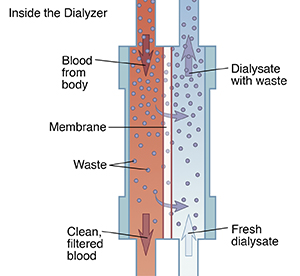
Hemodialysis is a type of treatment for kidney failure (end-stage kidney disease or ESRD). It uses a machine that holds a filter called a dialyzer. As blood flows through the dialyzer, waste is removed and fluid and chemicals are balanced. Hemodialysis treatments are usually done at a special dialysis center. In some cases, treatments may be done at home. As the kidney failure is getting worse, your doctor may advise you to have access placed by a surgeon into one of your arms ahead of time. This access may take several weeks to mature before it can be used for hemodialysis.
How hemodialysis is done
Two needles are inserted into a blood vessel (called an arteriovenous fistula or AV fistula) or arteriovenous graft (or AV graft), usually in your arm. Each needle is attached to a tube. One tube carries your blood into the dialyzer, where it's cleaned. Clean blood returns to your body through a second tube and needle. If the AV fistula or graft has been placed but it's not ready to use, or if options for permanent access aren't appropriate, you may have a dialysis catheter placed in a large blood vessel. The catheter is usually for temporary access. But if there is no other option, it may be used long-term (permanently). This catheter helps carry blood to and from the dialysis machine.
Your experience: Problems to watch for
-
Hemodialysis usually takes about
3 to 5 hours. It's usually done3 times a week. -
You’ll have a regular schedule for your hemodialysis. Many centers have evening and weekend hours as well as weekday hours to help you continue working. Some centers also offer overnight treatments.
-
A trained nurse or technician connects you to the dialysis machine. They watch for problems and make sure you are comfortable.
-
During treatment, only a small amount of blood (about
1 cup) is out of your body at any one time. -
During your treatments, you may have a headache, muscle cramps, nausea and vomiting, chest and back pain, itching, and fever and chills. Make sure you tell your nurse or technician if you have any of these symptoms.
-
Some people are able to learn to use a dialysis machine at home. Home dialysis lets you schedule treatments when it's most convenient. You may have more frequent treatments, but for shorter periods of time. You may also do overnight treatments.
Get immediate medical help or call your healthcare provider, nurse, or dialysis technician if you have any of these symptoms after treatment:
-
Chest or back pain
-
Tiredness (fatigue)
-
Bleeding from the needle site, if your dialysis access is through an AV fistula or graft
-
Drainage from the catheter exit site, if your dialysis access is through a catheter
-
Shortness of breath
-
Fever or chills
-
Headache or lightheadedness
-
Nausea or vomiting
-
Itching
-
Muscle cramps
-
Pain, warmth, or redness at your access site
-
Inability to feel your blood flow (called a thrill) in your AV fistula or graft, if your dialysis access is through an AV fistula or graft
Online Medical Reviewer: Heather M Trevino BSN RNC
Online Medical Reviewer: Marianne Fraser MSN RN
Online Medical Reviewer: Rajadurai Samnishanth
Date Last Reviewed: 09/01/2024
© 2000-2026 The StayWell Company, LLC. All rights reserved. This information is not intended as a substitute for professional medical care. Always follow your healthcare professional's instructions.
Learn More About Health Services at PIH Health
Expert care for every stage of life. Explore the comprehensive services offered at PIH Health.
Explore Services
Get Health Tips & Updates
Sign up for helpful health information, wellness tips and news from PIH Health, delivered straight to your inbox.
SubscribeRelated Articles
Treatment for Premature Ventricular Contractions (PVCs)
Premature ventricular contractions (PVCs) are a type of abnormal heartbeat (arrhythmia). They are very common. They can occur in people of all ages from time to time. They usually cause only mild symptoms.
The Clinical Cardiac Electrophysiologist
A clinical cardiac electrophysiologist, or cardiac EP, is a health care provider who treats rhythm problems of the heart. Learn more about their medical training, and the tests and procedures that they do.
What is a Central Venous Catheter for Hemodialysis?
Learn about using a central venous catheter for hemodialysis to clean your blood, if you have kidney failure.
Healthcare Providers for the Spine, Shoulder, or Pelvis
Detailed information on the healthcare providers and specialists who treat disorders of the spine, shoulder, and pelvis.

Personalized Care Starts with the Right Provider
Search by specialty, location, and more.
Find A Doctor
Make an Appointment
Your health can't always wait. Schedule an appointment with a PIH Health provider.
Schedule an Appointment
Find a PIH Health Urgent Care Location
Need care today?. Find the nearest PIH Health Urgent Care location.
Find Urgent Care