Healthcare providers use the term venous thromboembolism (VTE) to describe 2 conditions: deep vein thrombosis (DVT) and pulmonary embolism (PE). They use the term VTE because the 2 conditions are very closely related. And because how to prevent and treat them are closely related.
DVT is a blood clot (thrombus) in a deep vein. Most of these clots develop in the leg or thigh. But they may form in a vein in the arm or other part of the body.
Part of the blood clot may separate from the vein. This is called an embolus. It may travel to the lungs and form a pulmonary embolus. This can cut off the flow of blood to a portion of or to the entire lung. A blood clot in the lungs is a medical emergency. It may cause death.
Over time, blood clots can also damage veins. They must be treated right away to prevent problems.
Risk factors
Anyone can get a blood clot. But the following things make a blood clot more likely to happen:
-
Being inactive for a long period, such as when you’re in the hospital, or traveling by plane or car
-
Injury to a vein from an accident, a broken bone, or surgery
-
Having blood clots in the past or a family history of blood clots
-
Having a blood clotting disorder
-
Recent surgery
-
Having cancer and certain cancer treatments
-
Smoking
Other things can also put you at higher risk for a blood clot. They include:
-
Being older than 60
-
Being pregnant
-
Taking birth control pills or hormone replacement
-
Having other vein problems, such as varicose veins
-
Being overweight
-
Having a pacemaker or a central venous catheter. They increase the chance of a blood clot forming in an arm.
-
Using injected medicines. This also increases the chance of a blood clot forming in an arm.
Call 911
If you have symptoms of a blood clot in your lungs, call
-
Chest pain
-
Sudden shortness of breath
-
Trouble breathing
-
Fast heartbeat (palpitations)
-
Coughing (may cough up blood)
-
Sweating
-
Fainting, dizziness, lightheadedness
-
Anxiety
When to call your healthcare provider
If you have symptoms of a blood clot, call your healthcare provider. The symptoms are:
-
Pain
-
Swelling
-
Redness or change in color in a leg, arm, or other area
How to prevent DVT
Preventing a blood clot means improving blood flow back to your heart. To help prevent a blood clot:
-
Talk with your healthcare provider about a program of regular exercise.
-
If your legs feel swollen or heavy, take a break and sit comfortably or lie down with your feet up.
-
Stay at a healthy weight.
-
Quit smoking, if you smoke.
-
Don't sit, stand, or lie down for long periods without moving your legs and feet:
-
When traveling by car, stop often to get out and move around.
-
On long airplane, train, or bus rides, get up and move around when possible.
-
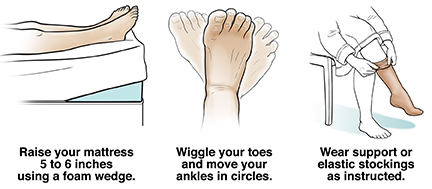
If you can’t get up, wiggle your toes, and tighten your calves to keep your blood moving, as pictured below.
-
If you need to have surgery, talk with your provider about a plan to prevent blood clots.
Your risk for blood clots increases if you are in the hospital. Your provider may prescribe blood-thinner medicine (anticoagulant) to help prevent blood clots. Or they may prescribe a sequential compression device (SCD) or intermittent pneumatic compression (IPC). These devices have sleeves that fit around your legs. They put gentle pressure on your legs to help with blood flow and prevent blood clots. Remove the sleeves so that you don't trip or fall when you are walking, such as when you use the bathroom or shower. If you need help removing the sleeves, ask the nurse or aid. You may also want to try the following:
Online Medical Reviewer: Deepak Sudheendra MD
Online Medical Reviewer: L Renee Watson MSN RN
Online Medical Reviewer: Rita Sather RN
Date Last Reviewed: 04/01/2024
© 2000-2026 The StayWell Company, LLC. All rights reserved. This information is not intended as a substitute for professional medical care. Always follow your healthcare professional's instructions.
Learn More About Health Services at PIH Health
Expert care for every stage of life. Explore the comprehensive services offered at PIH Health.
Explore Services
Get Health Tips & Updates
Sign up for helpful health information, wellness tips and news from PIH Health, delivered straight to your inbox.
SubscribeRelated Articles
Understanding Orthostatic Hypotension
Orthostatic hypotension is low blood pressure when you stand up from sitting or lying down. It can cause symptoms for such as dizziness, lightheadedness, and blurry vision. It may also cause fainting and falls.
Understanding Temporal Artery Biopsy
During a temporal artery biopsy, the doctor will remove a small sample of tissue from one or both of your temporal arteries.
Endovenous Laser Varicose Vein Surgery
Endovenous laser varicose vein surgery is a procedure that uses heat from a laser to reduce varicose veins. Varicose veins are swollen, bulging veins that often happen on the thighs or calves. A laser is a device that sends a thin beam of radiation in the form of light.
Marfan Syndrome in Adults
Marfan syndrome is a rare genetic disorder. It affects the body's connective tissue.
Personalized Care Starts with the Right Provider
Search by specialty, location, and more.
Find A Doctor
Make an Appointment
Your health can't always wait. Schedule an appointment with a PIH Health provider.
Schedule an Appointment
Find a PIH Health Urgent Care Location
Need care today?. Find the nearest PIH Health Urgent Care location.
Find Urgent Care