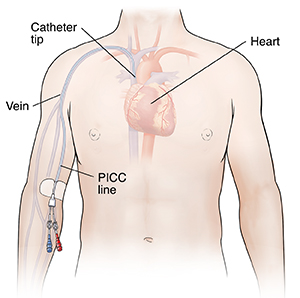
You need a peripherally inserted central catheter (PICC) for your treatment. A catheter is a small, soft tube. It is inserted into a vein in your arm. It is then moved through your vein until the tip sits in the large vein (vena cava) near your heart. A PICC is often used when treatment requires you to have medicine or nutrition for weeks or months.
When you no longer need the PICC, your health care provider will remove it by gently pulling out the catheter, holding pressure at the site, and then covering the site with a small bandage. Your skin will then heal.
This article tells you more about a PICC and how a provider places it in your body.
Why do I need a PICC?
A PICC takes the place of a standard IV (intravenous) line. A standard IV needs to be changed every few days. Since the PICC can stay in place longer, you may have fewer needle sticks during your treatment. There is less damage to the small veins where an IV would normally be inserted. Your health care provider can give you more details about why you need the PICC.
Getting a PICC
A short procedure is done to place the PICC in your body. This will be done in your hospital room, the radiology department, or somewhere else in the hospital. The procedure may vary slightly from the steps described here. Your care team can tell you what to expect. In general, during PICC placement:
-
You’re fully covered with a large sterile sheet (drape). This lowers the risk for infection. Only the area where the PICC will be placed is exposed. The skin is first cleaned with an antiseptic solution.
-
Ultrasound images may be viewed on a video screen. These are used to help find the best vein to use.
-
The area where the PICC will be inserted is numbed with an injection of local anesthetic medicine. This decreases discomfort during the PICC placement.
-
After the local anesthetic takes effect, the catheter is gently passed into the vein. It’s moved along until the tip is in the vena cava, close to the heart.
-
The other end of the catheter sticks out a few inches from your skin. It may be loosely attached to the skin with stitches (sutures) or a securement device. A dressing is placed over the area where the catheter enters your skin.
-
The health care provider will flush the catheter with saline solution to clear it. The solution may include heparin, which prevents blood clots.
-
An X-ray or other imaging test is done. This confirms the catheter’s position and checks for problems.
Risks and complications
As with any procedure, getting a PICC has certain risks. These include:
-
Infection.
-
Bleeding problems.
-
An irregular heartbeat.
-
Injury to the vein or to lymph ducts near the vein.
-
Inflammation of the vein (phlebitis).
-
Clots or air bubbles in the bloodstream.
-
Blockage of the blood vessel where the catheter is inserted.
-
Clots in the vein that may travel to the lung (pulmonary embolism).
-
Nerve injury.
-
Accidental insertion into an artery instead of a vein.
-
Catheter not positioned correctly, or the catheter may move or migrate from its correct position.
Online Medical Reviewer: Raymond Kent Turley BSN MSN RN
Online Medical Reviewer: Rita Sather RN
Online Medical Reviewer: Shaziya Allarakha MD
Date Last Reviewed: 02/01/2025
© 2000-2026 The StayWell Company, LLC. All rights reserved. This information is not intended as a substitute for professional medical care. Always follow your healthcare professional's instructions.
Learn More About Health Services at PIH Health
Expert care for every stage of life. Explore the comprehensive services offered at PIH Health.
Explore Services
Get Health Tips & Updates
Sign up for helpful health information, wellness tips and news from PIH Health, delivered straight to your inbox.
SubscribeRelated Articles
Potassium
Learn about the medical uses, claims, and side effects of potassium.
Ileostomy: Nutritional Management
You don't have to eat a special diet just because you've had an ileostomy. Most foods, chewed well and eaten slowly, won't give you problems, unless they did before. But you may need to be more aware of foods that make your stool more watery than normal and foods that cause gas or odor. You also need plenty of fluids and vitamins.
Low-Salt Choices
Here are some ideas for low-salt foods you can easily prepare yourself.
Vitamin E
Learn about the medical uses, claims, and side effects of vitamin E.

Personalized Care Starts with the Right Provider
Search by specialty, location, and more.
Find A Doctor
Make an Appointment
Your health can't always wait. Schedule an appointment with a PIH Health provider.
Schedule an Appointment
Find a PIH Health Urgent Care Location
Need care today?. Find the nearest PIH Health Urgent Care location.
Find Urgent Care