The job of the kidneys is to remove waste and extra water from the body. The kidneys also balance levels of minerals in the body, called electrolytes. Kidneys are essential for the health of the body. People with severe kidney disease are not able to perform these functions. This may be due to a temporary or a permanent kidney condition. Hemodialysis is a treatment that takes over the essential functions of the kidney until you recover from kidney disease or get a kidney transplant. If you have end-stage renal disease (ESRD) and are not eligible for a transplant, you will need to have hemodialysis for the rest of your life. Peritoneal dialysis is another type of dialysis. But it's not covered in this article.
Hemodialysis requires access to a strong blood flow. There are three ways to do this.
- Dialysis catheter. This is a plastic tube put into a large blood vessel, usually for temporary access. If there is no other option, it may be used permanently.
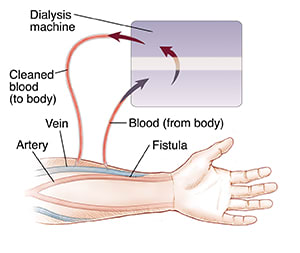
- AV fistula. Through a minor surgical procedure, an artery in your arm is joined directly to a vein. This creates an arteriovenous fistula, or AV fistula. The pressure of the arterial blood flow slowly expands the size of the attached vein. It may take up to 4 to 6 weeks for the fistula to enlarge enough to be ready for dialysis. The AV fistula is the access of choice. This is because there are typically fewer problems and side effects. It also lasts longer than the other options.
- AV graft. This is an artificial implant. It joins an artery and vein in people with small veins. It can also be used when an AV fistula did not work. It can be used for dialysis a few weeks after the surgery.
A connecting tube carries blood from the access point in the body to the dialysis machine. Then, special filters called dialyzers filter and process the blood. The blood is then returned to the body through a separate tube and needle. This takes 3 to 4 hours. It's usually done 3 times a week. Home dialysis is an option for some people.
Hemodialysis is lifesaving for people with kidney failure. But there are possible side effects. These include infection, low blood pressure, bleeding, electrolyte imbalance, anemia, and heart disease. People on hemodialysis are educated and closely monitored to minimize these risks as much as possible.
Home care
The following guidelines will help you care for yourself at home:
- Take any medicines as directed.
- Follow the special diet for kidney failure that your doctor gave you.
- Don't wear any clothing or jewelry that could put pressure on the access site.
- Don't lie on the access site while sleeping.
- If the access is in your arm, have blood pressure readings and blood samples taken from the other arm.
- Check the access site after dialysis for swelling, bleeding, or signs of infection.
- If you have an AV fistula or graft, check the site regularly to be sure you can always feel the vibration (called the “thrill”) of blood flowing from artery to vein. Don't put lotions or other products on the access site.
- If you have an external dialysis catheter, don't do any physical activities that could pull on the catheter.
- Contact your doctor if you have any questions or concerns. Don't wait.
Follow-up care
Follow up with your doctor as advised.
Call 911
Call
- External catheter starts bleeding or opens to air
- Severe weakness, dizziness, fainting, drowsiness, or confusion
- Chest pain or shortness of breath
When to seek medical advice
Contact your doctor right away if any of these occur:
- Color of the blood in the external tubing changes from bright red to dark red
- You don't feel the “thrill” (vibration) in an AV fistula or graft
- Nausea or vomiting
- Unexpected weight gain or swelling in the legs, ankles, or around the eyes
- Decreased or absent urine output if you previously made urine
- Fever of
100.4 ºF (38 ºC) or higher, or as directed by your doctor
Online Medical Reviewer: Marianne Fraser MSN RN
Online Medical Reviewer: Raymond Kent Turley BSN MSN RN
Online Medical Reviewer: Walead Latif MD
Date Last Reviewed: 09/01/2025
© 2000-2026 The StayWell Company, LLC. All rights reserved. This information is not intended as a substitute for professional medical care. Always follow your healthcare professional's instructions.
Learn More About Health Services at PIH Health
Expert care for every stage of life. Explore the comprehensive services offered at PIH Health.
Explore Services
Get Health Tips & Updates
Sign up for helpful health information, wellness tips and news from PIH Health, delivered straight to your inbox.
SubscribeRelated Articles
Discharge Instructions After an Organ Transplant
This sheet includes ways to protect yourself from infection after your transplant. You will continue these precautions until your health care provider tells you to stop. You may need to follow these guidelines for the rest of your life.
Kidney Bruise
Some injuries can bruise your kidney. This may cause blood to appear in your urine. The blood may be in small amounts that you can't see or it might color your urine pink or light red.
Flushing Your Implanted Access Port
Watch how your implanted access port will be flushed to clean it on the inside in order to prevent infection and clotting.
Urine Strainer
A urine strainer is used to collect a kidney stone from the urine stream. Learn how to use a urine strainer.

Personalized Care Starts with the Right Provider
Search by specialty, location, and more.
Find A Doctor
Make an Appointment
Your health can't always wait. Schedule an appointment with a PIH Health provider.
Schedule an Appointment
Find a PIH Health Urgent Care Location
Need care today?. Find the nearest PIH Health Urgent Care location.
Find Urgent Care