An evaluation helps your eye health care provider learn more about your vision problems. They can tell if cataracts are the cause. This evaluation includes a health history, vision tests, and an eye exam. What your provider learns will help them find the best treatment choices for you.
Health history
You will be asked questions about your vision and any other eye problems you may have. Your eye health care provider will also ask about health problems, such as diabetes. Be sure to tell your provider about any recent health conditions. Tell them about all medicines, vitamins, herbs, and other supplements you are taking.
Vision tests
Your eye health care provider will do a few tests to check your vision. You will read from an eye chart. Your vision will be tested under different lighting. Bring eyeglasses or contact lenses if you wear them. Your provider can check your prescription.
An eye exam
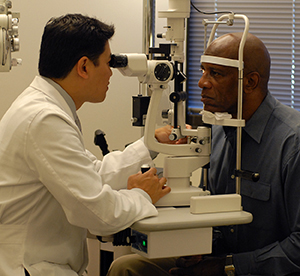
In most cases, you will be given eye drops to widen (dilate) your pupils before your exam. During the exam, the health care provider will look inside your eye using special equipment. This includes a microscope with a bright light (a slit lamp). Your provider will also use a lighted tool (ophthalmoscope) to look at the back part of your eye, called the retina.
Discussing treatment choices
After your eye exam, you and your eye health care provider will talk about your treatment choices. A new eyeglass or contact lens prescription may help your vision for a while. But surgery is the only way to remove a cataract and replace your cloudy lens. You may want to wait to have your cataract removed if you can still do your daily activities without any problems. You and your provider will decide what’s best for you.
Note
If you decide to have cataract surgery, the length of your eye and curvature of your cornea will be measured. This information helps your health care provider choose a new lens to replace your cloudy lens. Measurement is done using special tools. These may include an A-Scan, laser interferometry, a keratometer, or a topographer.
Online Medical Reviewer: Daphne Pierce-Smith RN MSN
Online Medical Reviewer: Sravani Chintapalli Researcher
Online Medical Reviewer: Whitney Seltman MD
Date Last Reviewed: 04/01/2025
© 2000-2026 The StayWell Company, LLC. All rights reserved. This information is not intended as a substitute for professional medical care. Always follow your healthcare professional's instructions.
Learn More About Health Services at PIH Health
Expert care for every stage of life. Explore the comprehensive services offered at PIH Health.
Explore Services
Get Health Tips & Updates
Sign up for helpful health information, wellness tips and news from PIH Health, delivered straight to your inbox.
SubscribeRelated Articles
Fluorescein Angiography
Learn about fluorescein angiography, an eye test that lets your healthcare provider examine the back of your eyes.
Bleeding in the Front of the Eye (Hyphema)
Hyphema is bleeding in the front part of your eye.
Eye Twitching
An eye twitch is an automatic blinking of your eyelid that you can't control. This abnormal blinking may happen many times a day. If eye twitching is severe, it can cause problems with your eyesight.
Trabeculectomy
Trabeculectomy is a type of surgery done in the front part of your eye to treat glaucoma. It lowers the pressure in your eye.

Personalized Care Starts with the Right Provider
Search by specialty, location, and more.
Find A Doctor
Make an Appointment
Your health can't always wait. Schedule an appointment with a PIH Health provider.
Schedule an Appointment
Find a PIH Health Urgent Care Location
Need care today?. Find the nearest PIH Health Urgent Care location.
Find Urgent Care