Minor muscle or joint injuries are often treated with an elastic bandage. The bandage provides support and compression to the injured area. An elastic bandage is a stretchy, rolled bandage. Elastic bandages range in width from 2 to 6 inches. They can be used for a variety of injuries. The bandages are often called ACE bandages, after a common brand name.
If used correctly, elastic bandages help control swelling and ease pain. An elastic bandage is also a good reminder not to overuse the injured area. However, elastic bandages don't provide a lot of support and will not prevent reinjury.
Home care
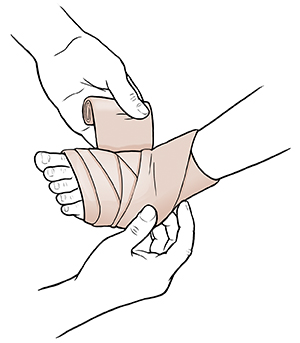
To apply an elastic bandage:
-
Check the skin before wrapping the injury. It should be clean, dry, and free of drainage.
-
Start wrapping below the injury and work your way toward the body. For an ankle sprain, start wrapping around the foot and work up toward the calf. This will help control swelling.
-
Overlap the edges of the bandage so it stays snugly in place.
-
Wrap the bandage firmly, but not too tightly. A tight bandage can increase swelling on either end of the bandage. Make sure the bandage is wrinkle free.
-
Leave fingers and toes exposed.
-
Secure ends of the bandage (even self-sticking ones) with clips or tape.
-
Check often to be sure there is good circulation, especially in the fingers and toes. Loosen the bandage if there is local swelling, numbness, tingling, discomfort, coldness, or discoloration (skin pale or bluish in color).
-
Rewrap the bandage as needed during the day. Reroll the bandage as you unwind it.
Continue using the elastic bandage until the pain and swelling are gone or as your child's health care provider advises.
If you have been told to ice the area, the ice can be secured in place with the elastic bandage. Wrap the ice pack with a thin towel to protect the skin. Don't put ice or an ice pack directly on the skin. Ice the area for no more than 20 minutes at a time.
Follow-up care
Follow up with your child's health care provider as advised.
When to call the doctor
Contact your child's health care provider if:
-
The pain and swelling doesn't get better or gets worse.
-
Your child has trouble moving injured area.
-
Skin discoloration, numbness, or tingling doesn’t go away after the bandage is removed.
Featured in
Online Medical Reviewer: Marianne Fraser MSN RN
Online Medical Reviewer: Raymond Turley Jr PA-C
Online Medical Reviewer: Thomas N Joseph MD
Date Last Reviewed: 01/01/2025
© 2000-2026 The StayWell Company, LLC. All rights reserved. This information is not intended as a substitute for professional medical care. Always follow your healthcare professional's instructions.
Learn More About Health Services at PIH Health
Expert care for every stage of life. Explore the comprehensive services offered at PIH Health.
Explore Services
Get Health Tips & Updates
Sign up for helpful health information, wellness tips and news from PIH Health, delivered straight to your inbox.
SubscribeRelated Articles
Broken Thumb (Child)
Your child has a fracture (broken bone) in the thumb. A broken thumb will likely be painful, swollen, and bruised. Here's how to care for your child at home.
Child Health Emergencies
A good guideline to follow is that a medical emergency is any time your child has an injury or illness you believe threatens their health or may cause permanent harm.
Carbon Monoxide Poisoning (Child)
Carbon monoxide is a gas that's produced by burning fuels. It has no color or odor. If it builds up in an enclosed area without enough ventilation, it can be poisonous to humans.
Hand or Finger Crush Injury, No Fracture (Child)
Your child has a crush injury of the hand, finger(s), or both. A crush injury happens when a large amount of pressure is put on part of the body. This squeezes the area between two surfaces. Your child has no broken bones, but tissue has been damaged. Learn details about caring for your child at home.

Personalized Care Starts with the Right Provider
Search by specialty, location, and more.
Find A Doctor
Make an Appointment
Your health can't always wait. Schedule an appointment with a PIH Health provider.
Schedule an Appointment
Find a PIH Health Urgent Care Location
Need care today?. Find the nearest PIH Health Urgent Care location.
Find Urgent Care