Diagnosing a middle ear problem takes several steps. You may be asked questions about your child’s health history. Your child’s eardrums will be examined. Tests may be done to check the health of the middle ear. Other tests may be done to check for hearing loss. Below is more information about the exam and tests.
Physical exam
A physical exam helps figure out the type of ear problem your child may have. The exam will also help identify respiratory illnesses. These can include bronchitis, pneumonia, or strep throat. They can affect middle ear health and hearing. The exam includes listening to your child’s heart and lungs. The health care provider will look in your child’s ears, nose, and throat.
Viewing the eardrum
A test called pneumatic otoscopy may be done. It takes a few minutes. In most cases, it does not cause any pain. A special device (otoscope) is used to look down the ear canal. This lets the health care provider see the eardrum and any fluid behind it. The device can also be used to change the air pressure in the ear canal. This lets the provider see how flexible the eardrum is. Reduced eardrum flexibility is often linked with fluid buildup.
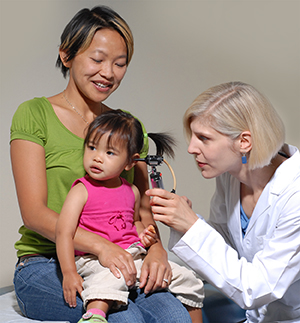
Checking the middle ear
Your child’s eardrum and middle ear may be tested. Tympanometry and acoustic reflex testing may be done. Both use a probe to send air and sound through the outer ear. Tympanometry measures the sound passed into the middle ear. Acoustic reflex testing checks the flexibility of the eardrum and how it responds to loud sounds.
Identifying hearing loss
Older children may be given an audiometric test. This measures any possible hearing loss. Test results are used to identify the types of sounds that can and can’t be heard. If your child is young, the health care provider or a hearing specialist may talk or play with them. The child’s response helps identify hearing loss.
Online Medical Reviewer: Ashutosh Kacker MD
Online Medical Reviewer: Rita Sather RN
Online Medical Reviewer: Tara Novick BSN MSN
Date Last Reviewed: 01/01/2025
© 2000-2026 The StayWell Company, LLC. All rights reserved. This information is not intended as a substitute for professional medical care. Always follow your healthcare professional's instructions.
Learn More About Health Services at PIH Health
Expert care for every stage of life. Explore the comprehensive services offered at PIH Health.
Explore Services
Get Health Tips & Updates
Sign up for helpful health information, wellness tips and news from PIH Health, delivered straight to your inbox.
SubscribeRelated Articles
Swimmer’s Ear in Children
Swimmer’s ear (otitis externa) is an inflammation of the external ear canal. Swimmer’s ear is caused by bacteria or fungi. Water that stays in the ear canal during swimming, for instance, may let bacteria and fungi grow.
Sinusitis in Children
Sinusitis is an inflammation of the sinuses that usually happens after a cold or with allergies. Here's what you need to know.
Types of Hearing Tests for Babies and Children
A look at the different types of hearing tests used for babies and children.
Thyroglossal Duct Cyst in Children
A thyroglossal duct cyst is a pocket in the front part of the neck that is filled with fluid. A child is born with this cyst.

Personalized Care Starts with the Right Provider
Search by specialty, location, and more.
Find A Doctor
Make an Appointment
Your health can't always wait. Schedule an appointment with a PIH Health provider.
Schedule an Appointment
Find a PIH Health Urgent Care Location
Need care today?. Find the nearest PIH Health Urgent Care location.
Find Urgent Care