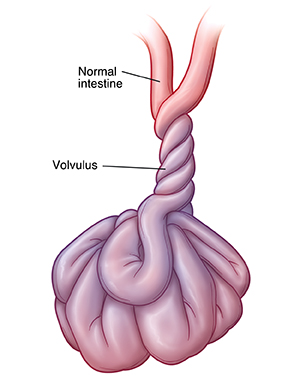
A volvulus occurs when the bowel (intestine) twists around itself and creates a blockage (obstruction). It can also cut off blood flow to part of the intestine. Without blood flow, that part of the intestine can die. A volvulus can cause serious digestive problems. It can even be fatal. Most often, a volvulus occurs in children younger than 1 year of age.
What causes a volvulus?
A volvulus often occurs in children with intestinal malrotation. This is a problem in which the intestine twists and turns the wrong way inside the belly (abdomen). A volvulus can also be caused by infection or blockage in the intestine. In some cases, a volvulus occurs for unknown reasons.
What are the symptoms?
Symptoms of a volvulus are often sudden and severe. They can include:
-
Severe belly pain (a baby may cry and not be soothed).
-
Nausea or vomiting. There may be green bile in the vomit.
-
Bloody stools.
-
Inability to pass stool.
-
A hard or swollen belly.
How is a volvulus treated?
A volvulus must be treated right away. It usually requires emergency surgery. During surgery:
-
The surgeon makes a cut (incision) in the belly.
-
The intestine is carefully untwisted.
-
If a part of the intestine has died from lack of blood flow, it is removed. The surgeon then reconnects the healthy ends of the intestine.
-
If a long length of intestine is removed, the surgeon may have to create a small opening (stoma) in your child’s belly. This gives a new way for waste to leave the body. If your child needs a stoma, the doctor will tell you more.
In some cases, a procedure called a colonoscopy or sigmoidoscopy can correct the problem. This involves the use of a flexible tube (scope) with a light on the end. The scope is passed into the colon (large bowel) through the rectum and sometimes can be used to untwist the intestine. But the child still may need surgery to prevent the problem from coming back.
What are the long-term concerns?
With treatment, your child will likely do well. But you should watch for signs of a volvulus in the future. If a long portion of intestine must be removed, your child may have lifelong digestive problems, such as short bowel syndrome. Your child may also be at risk for a blockage of the small bowel in the future. Talk with your child’s doctor about what to expect.
Featured in
Online Medical Reviewer: Chelsey Schilling BSN RN
Online Medical Reviewer: Daphne Pierce-Smith RN MSN
Online Medical Reviewer: Lalitha Kadali
Date Last Reviewed: 06/01/2025
© 2000-2026 The StayWell Company, LLC. All rights reserved. This information is not intended as a substitute for professional medical care. Always follow your healthcare professional's instructions.
Learn More About Health Services at PIH Health
Expert care for every stage of life. Explore the comprehensive services offered at PIH Health.
Explore Services
Get Health Tips & Updates
Sign up for helpful health information, wellness tips and news from PIH Health, delivered straight to your inbox.
SubscribeRelated Articles
Biliary Atresia in Children
Biliary atresia is a rare liver disease that occurs in infants. It is often found shortly after birth. The disorder affects tubes in the liver called bile ducts. If not treated with surgery, it can be fatal.
When Your Child Has Constipation
Constipation is a common problem in children. Your child has constipation if their poop is hard and dry. This often leads to straining or trouble pooping. Read on to learn more about symptoms and treatment.
Salmonella Gastroenteritis (Baby/Toddler)
Children can get salmonella from eating certain foods or water that has come into contact with the feces of an infected animal or person. Here's how to care for your child at home and what to watch for.
Dysphagia (Child)
Dysphagia is trouble swallowing. This means your child may choke when eating or drinking.

Personalized Care Starts with the Right Provider
Search by specialty, location, and more.
Find A Doctor
Make an Appointment
Your health can't always wait. Schedule an appointment with a PIH Health provider.
Schedule an Appointment
Find a PIH Health Urgent Care Location
Need care today?. Find the nearest PIH Health Urgent Care location.
Find Urgent Care