During an ileostomy, a surgeon either removes or disconnects your colon (large intestine). They may also disconnect part of the last section of your ileum. This is the last section of your small intestine. If your colon or ileum is diseased, the surgeon may remove the areas affected. If they are injured, they may be disconnected for a short time, while they heal. Your surgeon will bring the end of the ileum through your abdominal wall. They create an opening on the outside of your skin called a stoma. The stoma lets stool and mucus pass out of the body.
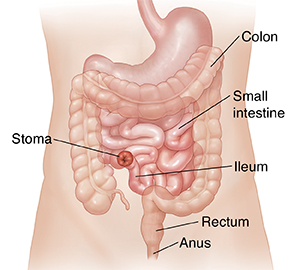
An end ileostomy
The most common type of ileostomy is the end ileostomy. For this type:
-
The surgeon removes or disconnects your colon, and possibly part of your ileum. They may also remove or disconnect your rectum and anus.
-
The stoma is most often created on the lower right side of your belly.
-
Stool tends to be quite liquid after this. This is because there is no colon to absorb water from the stool. The stool also contains digestive juices. This makes it very irritating to the skin.
-
An end ileostomy is often permanent. Your health care provider may do this surgery to treat inflammatory bowel disease. It may also be done to treat polyps (growths) in your intestine.
-
Sometimes an end ileostomy is temporary. Your provider may do this surgery to let your colon heal. It may be done after an injury.
There are other types of ileostomy. These can be temporary or permanent.
The stoma
-
Your surgeon creates the stoma by bringing the end of the ileum through a cut (incision) in your abdominal wall. The end of the ileum is then turned back on itself, like a cuff.
-
The stoma is pink and moist. This is because the inside of the ileum is the same kind of tissue as the inside of your mouth.
-
The stoma is then covered with a special appliance. This will fit tightly and collect stool. It will also decrease skin irritation and eliminate odor. You will be taught how to care for this.
-
The stoma shrinks to its final size about 6 to 8 weeks after surgery. Then it will be round or oval and sit about 1/4 to 1/2 inch above your skin.
-
Both stool and mucus pass through the stoma. If your anus is not removed, some mucus may pass from your anus as well.
Online Medical Reviewer: Jen Lehrer MD
Online Medical Reviewer: L Renee Watson MSN RN
Online Medical Reviewer: Rita Sather RN
Date Last Reviewed: 02/01/2025
© 2000-2026 The StayWell Company, LLC. All rights reserved. This information is not intended as a substitute for professional medical care. Always follow your healthcare professional's instructions.
Learn More About Health Services at PIH Health
Expert care for every stage of life. Explore the comprehensive services offered at PIH Health.
Explore Services
Get Health Tips & Updates
Sign up for helpful health information, wellness tips and news from PIH Health, delivered straight to your inbox.
SubscribeRelated Articles
Hernia Repair Surgery
A hernia won't heal on its own. You'll need surgery to fix the defect in the abdominal wall. Read on to learn what to expect before, during, and after surgery.
Treating Dysphagia
After a medical evaluation to find the cause of your dysphagia, your healthcare provider will create a treatment plan for you. You may need to take medicines. In some cases, your provider may suggest an esophageal dilation or surgery.
Understanding Fecal Transplant
Fecal transplant is used for treat an infection in the large bowel (colon) caused by C. diff bacteria.
Having Hernia Surgery: Patch Repair
Read on to learn what to expect before, during, and after hernia surgery with a patch repair.

Personalized Care Starts with the Right Provider
Search by specialty, location, and more.
Find A Doctor
Make an Appointment
Your health can't always wait. Schedule an appointment with a PIH Health provider.
Schedule an Appointment
Find a PIH Health Urgent Care Location
Need care today?. Find the nearest PIH Health Urgent Care location.
Find Urgent Care