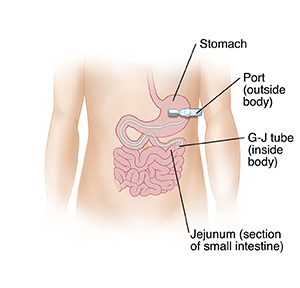
You are going home with a gastro-jejunum tube (G-J tube) in place. The G-J tube is put through the abdominal wall into your stomach. It extends into the jejunum, a part of the small intestine.
The G-J tube sends liquid food directly to your stomach or small intestine. You have been given this tube specifically to get liquid food into your small intestine. The G-J tube gives you the nutrition you need.
What to know
There are many types of G-J tubes, syringes, and feeding pumps. Some syringes and tubes are twist on, and others have plug-in tips. Follow your doctor's specific directions for the type of supplies you have. Your tube and supplies may look or work differently from what are described and shown here. Follow the directions from your doctor or home health nurse.
Ask for phone numbers to call if you need help. Also make sure you have the phone number for your medical supply company. You’ll need to order more supplies in the future.
Feeding with a G-J tube
You’ll need to feed yourself through the tube. Your doctor or home health nurse will show you how to do it. You will also learn how to vent air when needed and how to check the balloon if your tube uses a balloon anchor system. If you need more help, talk with your doctor or home health nurse.
You have 2 ports at the end of your tube. One is the gastric port (G-port) that goes directly to your stomach. The other is the jejunal port (J-port). Make sure you know which is the J-port. Only use the J-port for liquid food. You may also put liquid medicine in it, if needed. But never put crushed medicine into the J-port.
Ask your doctor if taking medicine by mouth with a sip of water is preferred. If you are not able to take medicine by mouth for any reason, you can put crushed medicine through the G-port using the correct method.
Types of feeding
There are 3 types of feeding with a G-J tube. You may have one or a combination of these. They are:
-
Continuous feeding. This type of feeding is recommended when feeding into the J-port. Liquid food is dripped slowly through the tube for part or all of a day. Continuous feeding is only done using a pump. The amount of food to be given and the time frame are often set on the pump for you. Don't change pump settings unless you’re told to do so.
-
Bolus feeding. This is a meal-sized amount of liquid food given through the tube several times a day. Bolus feeding is given using a syringe or a pump. Bolus feeding is done into the stomach (G-port) but not into the jejunum (J-port). Your doctor or home health nurse will tell you how much liquid food to use for each feeding. You’ll also be told how often to feed yourself.
-
Gravity feeding. A set amount of formula is placed in a feeding bag. It's allowed to flow slowly through the tube for at least 30 minutes per feeding.
Flushing the G-J tube
Your health care team will show you how to flush the tube. Make sure you flush the tube regularly as directed to keep it from being clogged. Also make sure you know what not to put in the tube, such as whole pills. If you need help, talk with your doctor or home health nurse.
When to call your doctor
Contact your doctor right away if:
-
You have trouble breathing.
-
The tube feels loose or comes out.
-
The opening where the tube enters the skin becomes larger.
-
Red, rough tissue forms around the tube site.
-
The tube becomes clogged or blocked and you can't clear it.
-
The skin around the tube site has redness, swelling, leaking fluid, or sores.
-
You see blood around the tube, in your stool, or in the stomach contents.
-
You cough, choke, or vomit while feeding.
-
Your belly looks bloated or feels hard when gently pressed.
-
You have diarrhea or constipation.
-
You have a fever of 100.4°F (38°C) or higher, or as directed by the doctor.
Date Last Reviewed: 07/01/2025
© 2000-2026 The StayWell Company, LLC. All rights reserved. This information is not intended as a substitute for professional medical care. Always follow your healthcare professional's instructions.
Learn More About Health Services at PIH Health
Expert care for every stage of life. Explore the comprehensive services offered at PIH Health.
Explore Services
Get Health Tips & Updates
Sign up for helpful health information, wellness tips and news from PIH Health, delivered straight to your inbox.
SubscribeRelated Articles
Colostomy: Selecting Your Pouch
After a colostomy, stool is most often collected in a pouch that attaches to your body around the stoma. An adhesive skin barrier holds the pouch in place and keeps stool from leaking onto the skin. Most pouches are made of lightweight, odor-proof plastic. They lie flat against the body so they don't show or make noise.
Diet for Vomiting or Diarrhea (Adult)
Here's what to eat and drink for the first few days after you've had vomiting or diarrhea.
Lifestyle Management of Ulcerative Colitis
You can lead a full life even if you have ulcerative colitis. Focus on keeping your symptoms under control with diet, exercise, and stress relief. And don't let this disease isolate you. Read on to learn more.
Lifestyle Management of Crohn’s Disease
You can lead a full life even if you have Crohn's disease. Read on for some helpful diet and exercise tips. And find ways to cope--and help others--by joining a support group.
Personalized Care Starts with the Right Provider
Search by specialty, location, and more.
Find A Doctor
Make an Appointment
Your health can't always wait. Schedule an appointment with a PIH Health provider.
Schedule an Appointment
Find a PIH Health Urgent Care Location
Need care today?. Find the nearest PIH Health Urgent Care location.
Find Urgent Care