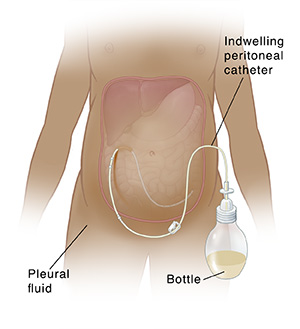
An indwelling peritoneal catheter is a thin, rubber tube. One end is placed in your belly (abdomen) and the other is outside your body. It’s used to drain fluid from the abdominal cavity (peritoneal cavity). It may be connected to a small bag that holds the fluid drained fluid. Or it may be connected to a suction device.
Abnormal buildup of fluid in the abdominal cavity is called ascites. This can cause pain, bloating, shortness of breath, and digestion problems. It can also cause weight gain, severe tiredness (fatigue), and swelling in the legs and ankles. Draining the fluid can ease these symptoms and help you feel better.
Ascites can be caused by:
-
Cirrhosis
-
Heart failure
-
Kidney failure
-
Some types of cancer
-
Hypoalbuminemia (low albumin). Albumin keeps fluid in your blood vessels.
Getting the abdominal catheter
The indwelling abdominal catheter (IAC) is put in place with a minor surgery. Your skin is cleaned and numbed with medicine. The healthcare provider makes a small cut (incision) in your skin. They gently put the catheter through the incision into the abdominal space. They use ultrasound or other imaging to guide this placement. One end of the tube stays outside your skin. A small piece of extra material on the tube just inside the skin helps it stay in place. This piece of extra material is called a cuff.
The catheter will drain extra fluid and ease your abdominal symptoms. It can be attached to a small bottle when it’s time to drain fluid. When not being used, the catheter is coiled next to your skin and covered with a dressing. The catheter will be left in place for weeks or months. Your healthcare team will tell you how long it will stay in place.
Caring for your abdominal catheter
-
Drain fluid with the catheter system exactly as instructed by your healthcare team. You may need to do this every 1 to 2 days.
-
You can shower if your catheter site is fully covered with a secure dressing that sticks to your skin. Make sure there are no gaps around the edge where it sticks to your skin. Follow any instructions from your healthcare team.
-
Don’t let your catheter go underwater. Do not take a bath, swim in a pool, or sit in a hot tub.
-
If any part of the padding under the dressing gets wet, you will need to remove it. Change it for dry padding as instructed.
Preventing infection
While you have an abdominal catheter, the areas affected by the catheter are at risk for infection. If you have signs of infection, you will need to take antibiotic medicine.
To help prevent infection:
-
Wash your hands before you touch the dressing or catheter.
-
When draining fluid, use only clean supplies set up in a clean area.
-
Make sure the catheter is always clean, dry, and covered when you are not draining fluid.
-
Don’t go into a pool or hot tub.
Watch for signs of infection. These can include:
-
Fever of 100.4ºF (38ºC) or higher, or as advised by your provider
-
Pain that gets worse
-
Redness, swelling, fluid, or warmth where the catheter goes into your skin
-
Changes in the way the fluid looks
When to call your healthcare provider
Call your healthcare provider right away if any of these happen:
-
You have signs of infection (see above)
-
Increase in pain
-
Wound opens
-
Leaking fluid (pus)
-
The small cuff just inside your skin has pulled out
-
The catheter has started to pull out
-
Not much fluid is draining
-
You are short of breath
-
Your symptoms don’t get better, or they get worse
-
Fever
Date Last Reviewed: 03/01/2024
© 2000-2026 The StayWell Company, LLC. All rights reserved. This information is not intended as a substitute for professional medical care. Always follow your healthcare professional's instructions.
Learn More About Health Services at PIH Health
Expert care for every stage of life. Explore the comprehensive services offered at PIH Health.
Explore Services
Get Health Tips & Updates
Sign up for helpful health information, wellness tips and news from PIH Health, delivered straight to your inbox.
SubscribeRelated Articles
Colostomy: Selecting Your Pouch
After a colostomy, stool is most often collected in a pouch that attaches to your body around the stoma. An adhesive skin barrier holds the pouch in place and keeps stool from leaking onto the skin. Most pouches are made of lightweight, odor-proof plastic. They lie flat against the body so they don't show or make noise.
Diet for Vomiting or Diarrhea (Adult)
Here's what to eat and drink for the first few days after you've had vomiting or diarrhea.
Self-Care for Vomiting and Diarrhea
Vomiting and diarrhea can make you feel awful. To get back to normal, start with self-care to ease your discomfort.
Lifestyle Management of Ulcerative Colitis
You can lead a full life even if you have ulcerative colitis. Focus on keeping your symptoms under control with diet, exercise, and stress relief. And don't let this disease isolate you. Read on to learn more.

Personalized Care Starts with the Right Provider
Search by specialty, location, and more.
Find A Doctor
Make an Appointment
Your health can't always wait. Schedule an appointment with a PIH Health provider.
Schedule an Appointment
Find a PIH Health Urgent Care Location
Need care today?. Find the nearest PIH Health Urgent Care location.
Find Urgent Care