You have diabetes. This means your body has trouble controlling blood sugar (glucose). Check your blood sugar level as directed by your healthcare provider to help manage your diabetes. Keep a log of your blood sugar levels to help you track it. It’s a simple and easy way to see how well you are controlling your diabetes.
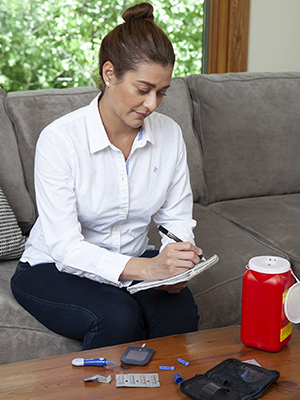
Checking your blood sugar level
Check your blood sugar with a blood glucose meter. First, wash your hands for 20 seconds and dry them. Next, you’ll prick the side of your finger with a tiny lancet or with a spring-loaded lancing device to draw a tiny drop of blood onto a test strip.
The strip goes into the meter first. Next, a drop of blood is placed on the tip of the strip. The meter shows your blood sugar level. Your readings should be in your target range as often as possible. This means not too high or too low. Staying in this range helps lower your risk for problems. Your healthcare provider will help you find the target range that is best for you.
Some glucose meters let you use another place on your body to test. But these other places should not be used in some cases because they may not be accurate. Follow the instructions for your glucose meter. And talk with your healthcare provider before doing the test on other places.
Continuous glucose monitoring (CGM)
If you have type 1 or type 2 diabetes, continuous glucose monitoring (CGM) may help you manage your blood sugar better. It tracks your blood sugar level all day and night. This can help you make better choices about food and physical activities. It can help with taking medicines. It can also find trends that can help your healthcare provider better manage your diabetes. CGM also gives you the percentage of time your blood sugar has been in the normal range. It also tells you when it's been too high or too low. This is called time-in-range. For most people, the target is 70% and the target range is between 70 and 180 mg/dL. Your range is based on your age and other factors.
Your healthcare provider may consider CGM if you are newly diagnosed and need to take insulin. It’s best for people who need to have tight blood sugar control. It also helps people who may not notice symptoms of low blood sugar. Ask your healthcare provider if CGM is right for you.
Several CGM devices are available. They are approved by the FDA. Your provider will need to prescribe the device for you. The device includes a sensor, transmitter, and a receiver or monitor. The sensor is a small device placed under the skin. It measures your blood sugar every few minutes. A transmitter sends the information to a receiver. This may be a part of an insulin pump or a separate device. It may have an alarm to warn you or someone else if your blood sugar is too low or too high.
Your blood sugar may still need to be checked a few times a day with a regular glucose meter to check accuracy. The sensor under the skin needs to be replaced every 7 to 14 days. At least one model uses a sensor implanted under the skin. It can work for up to 180 days. Implanted sensors are placed and removed by your provider.
Tracking your readings
Record the readings in your log book or using an online app each time you check your blood sugar. Your meter may also have a memory feature. Your healthcare provider can check this at your next visit. Your healthcare provider may tell you to check your blood sugar in the morning, at bedtime, and before and after meals. Write down all of your numbers. Also use your log to record things that might have affected your blood sugar. Some examples include being sick or dehydrated. It may also include taking certain medicines, being physically active, feeling stressed, or skipping meals.
Lessons learned from your readings
Tracking your blood sugar readings helps you see patterns. This tells you how your actions affect your blood sugar. For instance, you may have higher numbers after eating certain foods. Or you may have lower numbers after exercise. This helps you understand how to stay in your target range.
Sharing your log with your healthcare team
Write questions in your blood sugar log. Bring the log and the glucose meter with you to all of your appointments. This can help your healthcare team make changes to your treatment plan, if needed. This may mean making changes in what you eat, what medicines you take, or how much you exercise.
To learn more
The resources below can help you learn more:
-
American Diabetes Association at www.diabetes.org or 800-342-2383
-
National Eye Institute at www.nei.nih.gov or 301-496-5248
-
Hormone Health Network at www.hormone.org or 800-467-6663
Author: jlombardi
Online Medical Reviewer: Michael Dansinger MD
Online Medical Reviewer: Raymond Kent Turley BSN MSN RN
Online Medical Reviewer: Rita Sather RN
Date Last Reviewed: 05/01/2016
© 2000-2026 The StayWell Company, LLC. All rights reserved. This information is not intended as a substitute for professional medical care. Always follow your healthcare professional's instructions.
Learn More About Health Services at PIH Health
Expert care for every stage of life. Explore the comprehensive services offered at PIH Health.
Explore Services
Get Health Tips & Updates
Sign up for helpful health information, wellness tips and news from PIH Health, delivered straight to your inbox.
SubscribeRelated Articles
Diabetes and Emotions: Managing Stress
Learn some strategies that can help you cope with stress.
Insulin: How to Use and Where to Inject
Insulin won't work if it's swallowed, so it must be given by injection. Your health care team will show you how to give insulin injections.
Choosing Fats Wisely When You Have Diabetes
Learn about the different fats found in foods, and how choosing healthy fats can help manage your diabetes and overall health.
Oral Medicines for Type 2 Diabetes
Diabetes pills can help to manage your blood sugar. These pills are not insulin. They work to manage your blood sugar in several ways. Read on to learn about the different types of pills for type 2 diabetes.

Personalized Care Starts with the Right Provider
Search by specialty, location, and more.
Find A Doctor
Make an Appointment
Your health can't always wait. Schedule an appointment with a PIH Health provider.
Schedule an Appointment
Find a PIH Health Urgent Care Location
Need care today?. Find the nearest PIH Health Urgent Care location.
Find Urgent Care