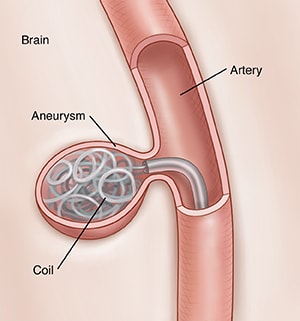
Embolization is a procedure used to treat a brain aneurysm. This is a bulge in the wall of a brain artery. If the aneurysm bursts (ruptures) and bleeds, nearby brain tissue may be damaged. This can cause a deadly stroke. This procedure may be done before an aneurysm bursts. It can help prevent these problems. It can also be done after an aneurysm has burst. The procedure is done by putting something inside the aneurysm. This may be metal coils, liquid, or special particles. This helps seal the aneurysm. It stops it from bleeding or rupturing.
Getting ready for your procedure
Embolization may be done as an emergency procedure after an aneurysm has burst. You or a family member should tell your doctor if you:
- Are pregnant or think you may be pregnant.
- Are breastfeeding.
- Are allergic to X-ray dye (contrast medium) or other medicines.
Also tell your doctor about any medicines you are taking. You may need to stop taking all or some of these before the procedure. This includes:
- All prescription medicines.
- Over-the-counter medicines, such as aspirin or ibuprofen.
- Other drugs.
- Herbs, vitamins, and other supplements.
Follow all directions you're given for not eating or drinking before the procedure.
Follow all other directions your care team gives you to get ready.
During your procedure
The procedure usually takes about 1 to 2 hours. In general, you can expect the following:
- You'll be given medicine (anesthesia). This is to stop you from feeling pain during the procedure. You may be given general anesthesia. This puts you into a state like a deep sleep. Or you may be given sedation with local anesthesia. Sedation makes you relaxed and sleepy. Local anesthesia numbs the areas to be worked on.
- The procedure is done with a long, thin tube (catheter). The doctor makes a small cut (incision) at the site where the catheter will be inserted. This is most often an artery in the groin. The catheter is moved through the artery all the way up to the brain.
- The doctor sends dye through the catheter. The dye makes it easier to see the artery and catheter on X-ray images. The catheter's movement can be seen on a video screen.
- The doctor uses the catheter to place metal coils, liquid, or special particles into the aneurysm. This causes a blood clot to form that seals the aneurysm and prevents bleeding.
- Then the catheter is removed. The incision in the groin is closed and bandaged.
After your procedure
You'll need to lie still for 4 to 6 hours after the procedure. Pressure may be applied to the site in your groin. This is to help reduce the risk of bleeding. After you're stable, you'll be moved to a hospital room.
You may need to stay in the hospital overnight even if the aneurysm had not yet ruptured. If it did rupture and cause a stroke, you'll stay in the hospital until you recover. This may be for 1 to 4 weeks. It depends on how much harm the aneurysm caused to your brain. While you're in the hospital, you'll have more imaging tests. They will show the coils, particles, or liquid in the aneurysm. The tests also help check that there is no more bleeding.
Risks and possible complications
All procedures have some risk. Risks of this procedure include:
- Bruising, bleeding, or infection at the catheter insertion site.
- Swelling or bleeding in the brain.
- Problems from the X-ray dye, including allergic reaction or kidney damage.
- Blood clots.
- Damage to an artery.
- Seizures.
- Stroke.
- Death.
If you had a stroke, you may also have short-term or long-term nervous system problems. These may include:
- Weakness.
- Paralysis.
- Confusion.
- Loss of vision, speech, or memory.
You may also need more treatment or surgery. This may be the case if treatment is not complete, or if an aneurysm occurs again.
Online Medical Reviewer: Anne Fetterman RN BSN
Online Medical Reviewer: Deepak Sudheendra MD
Online Medical Reviewer: Raymond Kent Turley BSN MSN RN
Date Last Reviewed: 09/01/2025
© 2000-2026 The StayWell Company, LLC. All rights reserved. This information is not intended as a substitute for professional medical care. Always follow your healthcare professional's instructions.
Learn More About Health Services at PIH Health
Expert care for every stage of life. Explore the comprehensive services offered at PIH Health.
Explore Services
Get Health Tips & Updates
Sign up for helpful health information, wellness tips and news from PIH Health, delivered straight to your inbox.
SubscribeRelated Articles
CT Scan of the Liver and Biliary Tract
A CT scan is a type of imaging test. It uses X-rays and computer technology to make images of the body. A CT scan can make detailed pictures of any part of the body, including the bones, muscles, fat, organs, and blood vessels. They are more detailed than regular X-rays.
Modified Barium Swallow
A modified barium swallow (also called a video fluoroscopic swallowing exam) is a test that checks your ability to swallow different consistencies of fluids and solid materials. It also helps in planning treatment, if needed.
First Aid: Seizures
Learn what to do, and when to call 911, when someone is having a seizure.
Spinal Fusion: Anterior Lumbar
Fusing vertebrae in the lumbar spine may help ease lower back and leg pain. Anterior lumbar fusion is done through an incision in your stomach area. Depending on how many vertebrae are fused, the surgery may take from 3 to 8 hours.

Personalized Care Starts with the Right Provider
Search by specialty, location, and more.
Find A Doctor
Make an Appointment
Your health can't always wait. Schedule an appointment with a PIH Health provider.
Schedule an Appointment
Find a PIH Health Urgent Care Location
Need care today?. Find the nearest PIH Health Urgent Care location.
Find Urgent Care